Waving palm branches and still missing the moment
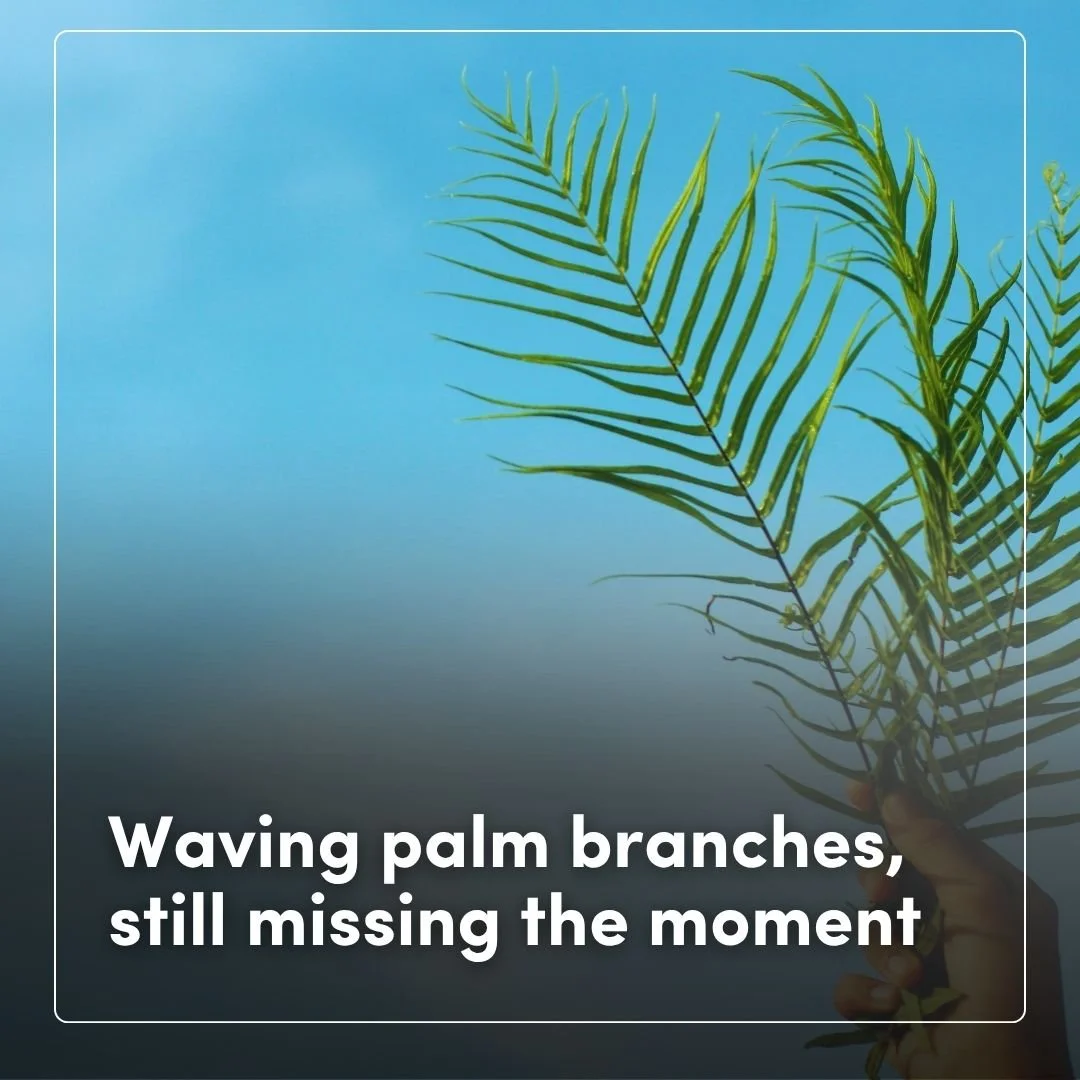
Years ago, when I was a children’s pastor, we made a big deal out of Palm Sunday. We went all in. I remember driving down to a local nursery earlier in the week and asking if they had palm branches we could take off their hands. We showed up with armfuls of them, handed them out to the kids, and turned the morning into a full-on parade singing “Hosanna, Hosanna, Hosanna in the highest.”
One year, we even rented a donkey so we could bring the story to life. It felt like the right thing to do, until we realized the guy we cast as Jesus weighed a little more than the rent-a-donkey had signed up for. It was memorable for all the wrong reasons, but the kids loved it. To them, Palm Sunday meant excitement, celebration, and waving branches as Jesus rode into Jerusalem.
At the time, I didn’t question it. That’s how most of us learned the story. Palm branches meant joy. They meant praise. They meant something like a victory parade.
But I was living in two very different worlds in those years, and it slowly started to reshape how I saw that moment. During the week and on Sundays, I was pastoring in a church context. But on Saturdays, on Shabbat, I was leading worship and youth in a Messianic Jewish congregation. Same Scriptures, same Messiah, but a different lens.
And then there was another time of year when I found myself back at that same nursery, asking for palm branches again. Not in the spring. Not around Passover. But in the fall, during Sukkot.
This time, the branches were not for a parade. They were for a sukkah.
If you’ve ever celebrated Sukkot, or the Feast of Tabernacles, you know the imagery. Leviticus 23:40 says,
“You shall take on the first day the fruit of splendid trees, branches of palm trees and boughs of leafy trees and willows of the brook, and you shall rejoice before the LORD your God seven days.”
Those palm branches were not random decorations. They were part of a command. Israel was to build temporary dwellings, sukkot, and live in them for a week as a reminder of their wilderness journey, when God dwelled with them, led them, and sustained them.
Palm branches, in that setting, carried a very specific meaning. They pointed to the presence of God among His people. They were tied to joy, yes, but not just any joy. They were tied to the joy of God drawing near. The hope of Sukkot looked forward as well as backward. It was not only about remembering the wilderness. It was about anticipating a day when God would once again dwell with His people in a full and lasting way. Zechariah speaks into that expectation:
“And the LORD will be king over all the earth. On that day the LORD will be one and his name one” (Zechariah 14:9)
And in that same chapter, the nations are pictured coming up to Jerusalem to celebrate the Feast of Tabernacles (Zechariah 14:16).
So when you step back into the first century and watch Jesus ride into Jerusalem, those palm branches take on a different tone. The people lining the streets are not just grabbing whatever is nearby to wave in the air. They are reaching for symbols loaded with meaning. In their world, palm branches were tied to the expectation that God would dwell with His people again, that His kingdom would be established, and that the story would reach its long-awaited fulfillment.
This helps us hear their words more clearly. “Hosanna! Blessed is He who comes in the name of the Lord!” (Psalm 118:25–26). As we’ve already seen, hosanna means “save us, please.” It is a prayer, not just a cheer. So now the scene sharpens. The crowd is waving palm branches, symbols of God dwelling with His people, while crying out for salvation. In their minds, these ideas belong together. God will come. God will save. God will reign. And they believe Jesus might be the one to bring it all together.
In a sense, they are not wrong.
John’s Gospel later captures a future vision that echoes this same imagery. In Revelation 7:9–10, we read, “After this I looked, and behold, a great multitude that no one could number… standing before the throne and before the Lamb, clothed in white robes, with palm branches in their hands, and crying out with a loud voice, ‘Salvation belongs to our God who sits on the throne, and to the Lamb!’” Palm branches and salvation are still connected. The hope of God dwelling with His people and reigning over them is still the end of the story.
But on that road into Jerusalem, the timing is not what the crowd assumes.
Sukkot expectations, Passover reality
This is where the tension of Palm Sunday becomes theological, not just emotional. The people are reaching for Sukkot language and imagery, for the hope of God tabernacling among them in a visible, reigning way. Yet the calendar is telling a different story. This is not the season of Tabernacles. It is the season of Passover.
Watch what happens here…
Because Passover is not about God taking His throne in Jerusalem. It is about deliverance through sacrifice. It is about a lamb, chosen and set apart. It is about blood on the doorposts and judgment passing over those who are covered by it. Exodus 12:3 instructs the people,
“Tell all the congregation of Israel that on the tenth day of this month every man shall take a lamb… a lamb for a household.”
That tenth day of Nisan is when the lambs are selected.
And it is on that same day that Jesus enters Jerusalem.
So while the crowd is reaching forward to Sukkot, Jesus is stepping into Passover. While they are anticipating enthronement, He is moving toward sacrifice. While they are waving branches that speak of God dwelling with His people, He is preparing to make a way for that to happen through His own death.
John has already framed this for us earlier in the Gospel: “Behold, the Lamb of God, who takes away the sin of the world” (John 1:29). What unfolds during this week is not a deviation from that identity. It is the fulfillment of it.
This does not mean the hopes tied to Sukkot are misplaced. It means they are not yet. The expectation that God will dwell with His people, that He will reign, and that His kingdom will be established is not corrected by Jesus. It is deferred and deepened. He will do those things. Scripture holds that promise firmly. “Behold, the dwelling place of God is with man. He will dwell with them, and they will be his people” (Revelation 21:3). That day is coming.
But before God dwells with His people in that final, visible way, something must be addressed. Sin. Death. Separation. The deeper exile that sits beneath every external oppression must be dealt with first. That is why this week moves toward a cross.
So when we return to the scene of Palm Sunday, we can now see the layers at work. The crowd is not foolish. They are reading their Scriptures. They are drawing from the language of the Psalms. They are acting out hopes rooted in the feasts. They are reaching for Sukkot while standing in Passover. Their cry of “hosanna” is real, and their use of palm branches is meaningful. But they are placing those expectations onto a moment that is designed for something else.
Jesus, for His part, is not rejecting their hope. He is fulfilling it in the only way it can truly be fulfilled. He does come to save. He does come to dwell. He does come to reign. But the path to that reality runs through the shedding of His blood as the Passover Lamb.
In that sense, Palm Sunday holds both truth and tension. It is a moment where the right symbols are present, the right words are spoken, and the right person is at the center, yet the timing and the means are still being revealed. The crowd sees enough to cry out, but not yet enough to understand.
And that brings the moment closer to us than we might expect.
We often pray in the same way. We reach for promises that are real. We long for outcomes that Scripture affirms. We ask God to act, to save, to step in. And He does. But the way He answers often moves deeper than what we initially had in mind. He addresses not only the surface of our need, but its root.
The name behind the cry
“Hosanna” is still a fitting word.
It is still the language of honest prayer. It still carries the weight of dependence. And it is still directed toward the one whose very name carries the answer.
The Hebrew phrase behind “hosanna” is הוֹשִׁיעָה נָּא (hoshi‘ah na), meaning “save us, please.” The verb הוֹשִׁיעָה (hoshi‘ah) comes from the root יָשַׁע (yasha), which means “to save” or “to deliver.”
That same root forms the word יְשׁוּעָה (yeshuah), meaning “salvation.”
And it is also the root of the name יֵשׁוּעַ (Yeshua), the name of Jesus.
So when the crowd cries out, “Hosanna,” they are, in a very real sense, calling out:
“Save us… to the One whose name means salvation.”
They are closer than they realize.
Palm Sunday reminds us that God does answer that cry. It also reminds us that His answer may lead us through places we did not anticipate. The crowd reached for Sukkot. Jesus walked them into Passover. And through that, He opened the way for a future where God will dwell with His people fully and forever.
The branches were not wrong.
The cry was not wrong.
The answer was already riding into the city.
About The Jewish Road
At the heart of The Jewish Road lies a passion ignited by a father-son duo, Ron and Matt Davis. Our journey began with a simple yet profound desire: to bridge the gap in understanding that has kept two faith communities apart for too long. We're here to help Christians connect with the roots of their faith and for Jews to explore the life and teachings of Jesus with an open heart.
Imagine a world where every believer, be they Jewish or Christian, not only knows their faith but truly understands its origins and interconnectedness. We strive to restore the Jewish essence of the Gospel, offering insights that deepen knowledge, bolster faith, and propel the growth of the Kingdom. The narrative of faith, we believe, is a two-act play where both acts are essential for a comprehensive grasp of the story. By uniting these acts, we're presenting a more holistic and enriching perspective.
Life is too short to wander without knowing the full essence of your beliefs. Whether you're attending a synagogue or a church, there's so much more to discover. The Jewish Road is here to guide, enlighten, and, most importantly, bring both halves of the story together. Join us on this journey; together