What’s so special about the land of Israel?
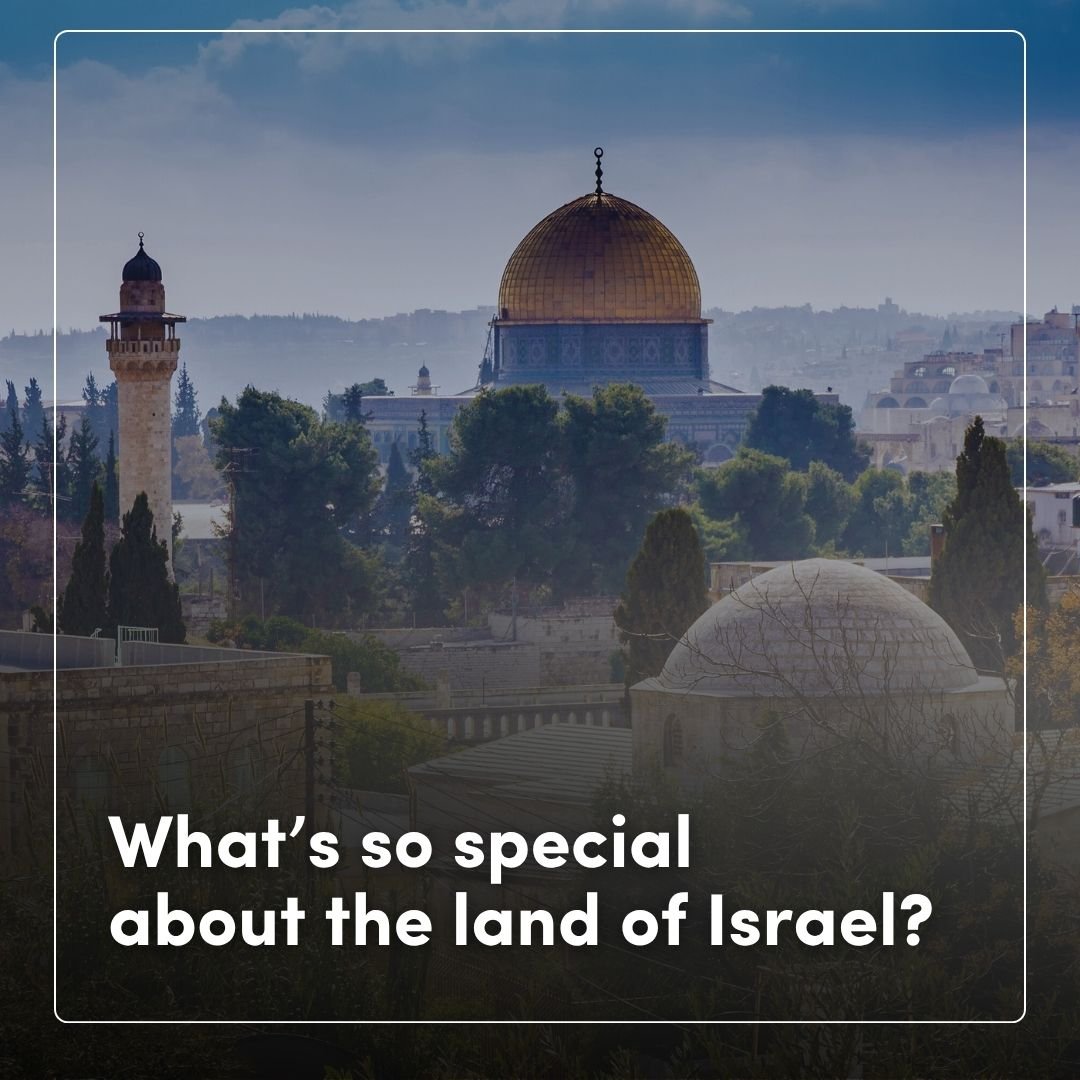
We are living in days that feel unsteady. Nations move, alliances shift, and Israel again sits at the center of the world’s attention. In moments like this, it is easy to see the land only through the lens of conflict. Scripture invites us to see something deeper. It asks us to consider not only what is happening on the land, but what God has said about it.
A foreigner and a handful of soil
One of the clearest windows into this comes from an unlikely place. The story of Naaman in 2 Kings 5 is not only about healing. It is about geography, identity, and how the God of Israel has chosen to make Himself known in the world.
Naaman is a commander from Aram, modern Syria. He is powerful, respected, and deeply in need. His leprosy marks him as both strong and broken at the same time. When he comes to Israel seeking healing, the prophet Elisha sends a simple instruction: wash in the Jordan seven times. Naaman resists, then obeys, and is restored.
The text says, “His flesh was restored like the flesh of a little child, and he was clean” (2 Kings 5:14).
Then something unexpected happens. Naaman turns to Elisha and says,
“If not, please let there be given to your servant two mule loads of earth, for from now on your servant will not offer burnt offering or sacrifice to any god but the LORD” (2 Kings 5:17).
He asks for soil.
This moment carries more weight than it first appears. Naaman has come to recognize that the God who healed him is not simply a distant deity. He is the God of Israel, the God who has made His name dwell in a specific place. In the ancient world, people understood divine presence as connected to territory. Naaman’s request shows that he now understands the God of Israel as the true God, yet he still wants to honor Him on ground associated with His presence. He wants to take a piece of that sacred space with him.
The Bible allows this moment to stand. That tells us something important. The land of Israel is not incidental to the story. It is part of how God chose to reveal Himself.
A land the Lord Himself cares for
Moses makes this explicit in Deuteronomy. As Israel prepares to enter the land, he describes it in a way that sets it apart from every other place:
“For the land that you are entering to take possession of is not like the land of Egypt… but the land that you are going over to possess is a land of hills and valleys, which drinks water by the rain from heaven, a land that the LORD your God cares for. The eyes of the LORD your God are always upon it, from the beginning of the year to the end of the year” (Deuteronomy 11:10–12).
This is a theological statement. God’s care is not abstract. It is directed. His attention rests on this land in a continuous way. That does not mean He is absent elsewhere. It means He has chosen this place as a focal point for His purposes in history.
Scripture continues to describe the land as good, rich, and life-giving:
“For the LORD your God is bringing you into a good land…a land of wheat and barley, of vines and fig trees and pomegranates, a land of olive trees and honey” (Deuteronomy 8:7–8).
The beauty of the land is tied to the presence of God. It reflects His provision and His promise.
How Scripture defines it
In recent days, Tucker Carlson described Israel in harsh terms, even calling it devoid of beauty and framing current events as a “war on beauty.”
“And being destroyed by Israel, which is one of the single ugliest countries in the world, nothing of beauty has been built there since 1948. Sorry, I've been everywhere in that country, and it's true.”
That is a sweeping claim. And it deserves more than a quick dismissal.
At one level, it is simply not true. Anyone who has stood in the Galilee at sunrise, watched the light move across the Judean hills, or walked the ancient stones of Jerusalem knows this land carries a kind of beauty that is hard to describe and even harder to forget. Vineyards stretch across the north. The desert holds a quiet, almost sacred stillness. The coastline opens wide to the Mediterranean. The land is small, yet it holds a remarkable range of life, texture, and color.
Since 1948, Israel has also built. Cities have risen. Agriculture has flourished in places that once lay barren. Forests have been planted. Water has been drawn from scarcity. There is beauty in what has been restored and cultivated, not only in what has been preserved.
But the deeper issue in that statement is not geography. It is definition.
It assumes beauty is measured only by what is visually pleasing, architecturally impressive, or culturally familiar. Scripture speaks about beauty with a different set of lenses.
The psalmist writes, “One thing have I asked of the LORD… to gaze upon the beauty of the LORD and to inquire in His temple” (Psalm 27:4).
In the Bible, beauty is often tied to presence, purpose, and what God is doing in a place. It includes the physical, yet it is not limited to it. It carries meaning.
The land of Israel holds this kind of layered beauty. It is the place where God entered into covenant with a people, where prophets spoke, where promises were given, and where those promises began to unfold in history. The hills, the valleys, the cities, and the wilderness all carry that weight.
When you stand in that land, you are not only seeing it. You are standing inside a story.
That is what Naaman recognized. He did not ask for a view or a monument. He asked for soil. He understood that something about that land was bound up with the God who had revealed Himself there.
So the question shifts.
It is not only, “Is this land beautiful?” It becomes, “Do we recognize the kind of beauty it carries?”
Scripture answers that by pointing us back to the God who has placed His name there and the story that continues to unfold through it.
A land of promise, and tension
The land has never been free from struggle. From the moment God said to Abraham, “To your offspring I will give this land” (Genesis 12:7), the story has included both promise and opposition.
This pattern continues throughout Scripture. The land is a gift, and it is also a place where faith is tested. It is where God’s purposes unfold through real people, real conflict, and real history.
That reality continues today. What we are witnessing is another chapter in a long story. The presence of conflict does not remove the significance of the land. It highlights how central it is.
Naaman’s insight
Naaman leaves Israel with more than healing. He leaves with a new understanding of God and a desire to anchor his worship to what he has experienced. The soil he carries is a sign that the encounter mattered, and that the place mattered.
His response gives us a way to think about the land today. It points to a reality that is easy to overlook. The land of Israel is not only a setting for biblical events. It is woven into the way God has revealed Himself.
That does not mean the land is the end of the story. It is part of a larger purpose.
God’s promise to Abraham makes that clear:
“In you all the families of the earth shall be blessed” (Genesis 12:3).
The land is central, yet the blessing moves outward. The prophets carry this forward:
“I will make you as a light for the nations, that my salvation may reach to the ends of the earth” (Isaiah 49:6).
The land is where the light is kindled. The intention is that it reaches the world.
Should we care today?
In a time of global tension, Scripture calls us back to a wider view. The land of Israel remains a place God has marked, cared for, and used in His unfolding plan.
So what is special about the land?
It is a place God has chosen.
It is a place where His presence has been revealed in history.
It is a place that carries both beauty and weight.
It is a place that still matters because God has said it does.
Naaman understood this in a simple way. He carried soil. We are invited to carry something deeper. We carry an understanding shaped by Scripture and a posture shaped by prayer.
“Pray for the peace of Jerusalem” (Psalm 122:6).
Keep praying that prayer.
Do you want to join us on our next trip to Israel? Find out more details here.


About The Jewish Road
At the heart of The Jewish Road lies a passion ignited by a father-son duo, Ron and Matt Davis. Our journey began with a simple yet profound desire: to bridge the gap in understanding that has kept two faith communities apart for too long. We're here to help Christians connect with the roots of their faith and for Jews to explore the life and teachings of Jesus with an open heart.
Imagine a world where every believer, be they Jewish or Christian, not only knows their faith but truly understands its origins and interconnectedness. We strive to restore the Jewish essence of the Gospel, offering insights that deepen knowledge, bolster faith, and propel the growth of the Kingdom. The narrative of faith, we believe, is a two-act play where both acts are essential for a comprehensive grasp of the story. By uniting these acts, we're presenting a more holistic and enriching perspective.
Life is too short to wander without knowing the full essence of your beliefs. Whether you're attending a synagogue or a church, there's so much more to discover. The Jewish Road is here to guide, enlighten, and, most importantly, bring both halves of the story together. Join us on this journey; together