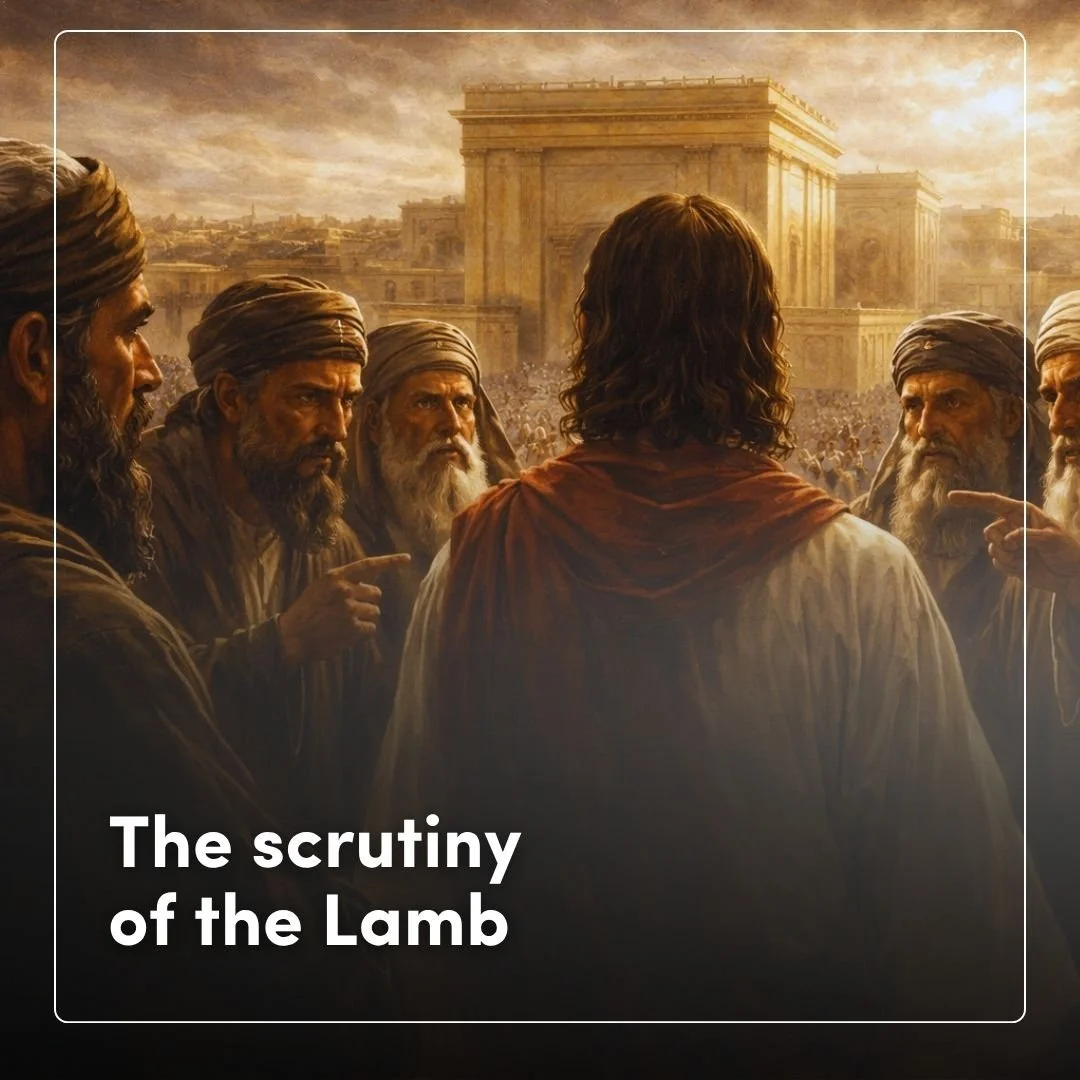
The scrutiny of the Lamb
Growing up, I spent a lot of Saturday mornings watching Wile E. Coyote chase the Road Runner. The pattern never really changed. He would design a trap with precision, step back with confidence, and wait for the moment it would all come together. And then, almost without fail, the very thing he built would turn on him.
The trap meant to expose weakness would end up revealing his own.
That rhythm, as simple as it is, becomes a helpful lens when we step into the final days of Jesus’ life. Because what unfolds in Jerusalem during that week carries a similar pattern, though far more weighty. The leaders of the day approach Jesus with carefully constructed questions. Each one is intentional. Each one is meant to corner Him, to expose Him, to discredit Him in front of the people.
And yet, as those moments play out, something unexpected happens: The questions do not unravel Him, but reveal Him.
The space between selection and sacrifice
We often speak about two key moments in the Passover story. The selection of the lamb on the 10th of Nisan and the sacrifice of the lamb on the 14th. Both moments carry deep meaning, and they frame the story of redemption.
But between those two days sits a space that often goes unnoticed.
In Exodus 12, the lamb chosen by each household is not immediately sacrificed. It is brought into the home and kept there for several days. During that time, it is seen, observed, and examined. The father of the house would ensure that the lamb was without spot or blemish (Exodus 12:3–6). The offering that would be given had to be worthy. It had to hold up under scrutiny.
It is the space where the lamb is tested.
And when we step into the Gospels with that pattern in mind, the days between Jesus’ triumphal entry and His crucifixion begin to take on a different kind of clarity.
Jesus enters Jerusalem on the 10th of Nisan. The crowds greet Him with palm branches and cries of “Hosanna,” calling out for salvation. It feels like a moment of arrival, a moment where expectation and hope meet in the streets.
Yet instead of moving toward a throne, Jesus moves toward the Temple.
From that point forward, the narrative slows down. The Gospel writers linger over the conversations, the confrontations, the questions. What can feel like a series of interruptions begins to show a deeper structure. These are not random encounters. They are part of a pattern:
The Lamb has been selected. Now the Lamb is being examined.
Every question is a test
The first challenge comes from the chief priests and elders. They approach Jesus in the Temple and ask,
“By what authority are you doing these things, and who gave you this authority?” (Matthew 21:23)
It is a direct question, aimed at the foundation of His identity. Authority sits at the center of everything.
Jesus responds with a question of His own, asking about the baptism of John. Their response reveals their position. They discuss among themselves, weighing the consequences of every possible answer. In the end, they step back and say they do not know. The exchange closes without resolution from them, yet something has already been made clear to those watching.
The next group approaches from a different angle. The Pharisees and Herodians come together with a political question.
“Is it lawful to pay taxes to Caesar, or not?” (Matthew 22:17)
The tension in the question is obvious. Any answer could be used against Him.
Jesus asks for a coin and directs their attention to the image on it.
“Render to Caesar the things that are Caesar’s, and to God the things that are God’s.”
The answer carries both clarity and depth. The text tells us they marveled. Then they went away.
The Sadducees enter next, bringing a theological question about the resurrection, something they themselves reject. They construct a detailed scenario designed to stretch the idea beyond reason. Jesus answers by anchoring His response in the Torah.
“I am the God of Abraham, and the God of Isaac, and the God of Jacob.” Then He adds, “He is not God of the dead, but of the living” (Matthew 22:32)
The crowd hears it and is astonished.
Each encounter builds on the last.
Authority.
Politics.
Theology.
Every angle that matters in that world is brought forward.
A scribe then steps into the conversation with a question about the greatest commandment. His tone carries a different weight. There is a sincerity in his approach. Jesus answers with the Shema, the central confession of Israel:
“Hear, O Israel: The Lord our God, the Lord is one.”
He pairs it with love for neighbor, drawing together the heart of the Law (Mark 12:29–31). The scribe recognizes the wisdom in the answer. Jesus tells him he is not far from the kingdom of God.
And then something shifts: The questions begin to fade.
The silence of the crowd
After these exchanges, the Gospels record a noticeable change. The stream of challenges slows, and then it stops. The leaders who came with questions step back. The traps that were carefully set no longer continue.
Jesus then turns the question back on them.
“What do you think about the Messiah? Whose son is He?” They answer, “The son of David.” Jesus follows with a question rooted in Psalm 110, asking how David can call his own descendant “Lord” (Matthew 22:41–45).
The room holds the question. No one answers. From that point forward, no one asks Him another question. The silence speaks. The Lamb has stood in the center of scrutiny, and every test has run its course.
Even Rome weighs in
The examination does not remain within the Temple courts. It extends beyond Israel’s religious leadership into the authority of Rome. Jesus is brought before Pilate, the Roman governor, who approaches the situation from a different perspective. His concern centers on order, stability, and political control.
Pilate questions Jesus. He listens. He observes. And then he says something that echoes through the rest of the story: “I find no guilt in Him” (John 18:38).
He says it again. And then again. From a completely different seat of authority, removed from the theological debates of Israel, the conclusion remains the same.
The Lamb stands without blemish.
When placed back into the framework of Exodus, the pattern becomes unmistakable.
The lamb is selected.
The lamb is scrutinized.
The lamb is sacrificed.
What can feel like a series of disconnected moments in the Gospels begins to align into a single, coherent movement. These days in Jerusalem are essential. They show us that the Lamb who will be offered has already been seen up close, tested from every angle, and found worthy.
Nothing hidden.
Nothing overlooked.
Nothing unresolved.
The leaders of Israel bring their questions. The systems of power apply their pressure. The voices of authority weigh in. And through it all, the Lamb remains whole.
The weight of those days
It is easy to move quickly through this part of the story, to go from the triumphal entry to the crucifixion without sitting in the days in between. Yet those days carry their own kind of weight. They show us that what happens at the cross is not sudden or uncertain. It is the culmination of something that has already been revealed.
The Lamb who is given has already stood in the center of every question. And He has not been undone by any of them. The traps set before Him have turned back on those who set them. The questions meant to expose weakness have instead revealed wisdom, authority, and identity. What remains at the end is not confusion, but clarity.
And then there is silence.
No one has anything left to ask.
The Lamb has been examined.
And He is ready.
About The Jewish Road
At the heart of The Jewish Road lies a passion ignited by a father-son duo, Ron and Matt Davis. Our journey began with a simple yet profound desire: to bridge the gap in understanding that has kept two faith communities apart for too long. We're here to help Christians connect with the roots of their faith and for Jews to explore the life and teachings of Jesus with an open heart.
Imagine a world where every believer, be they Jewish or Christian, not only knows their faith but truly understands its origins and interconnectedness. We strive to restore the Jewish essence of the Gospel, offering insights that deepen knowledge, bolster faith, and propel the growth of the Kingdom. The narrative of faith, we believe, is a two-act play where both acts are essential for a comprehensive grasp of the story. By uniting these acts, we're presenting a more holistic and enriching perspective.
Life is too short to wander without knowing the full essence of your beliefs. Whether you're attending a synagogue or a church, there's so much more to discover. The Jewish Road is here to guide, enlighten, and, most importantly, bring both halves of the story together. Join us on this journey; together