We are Barabbas
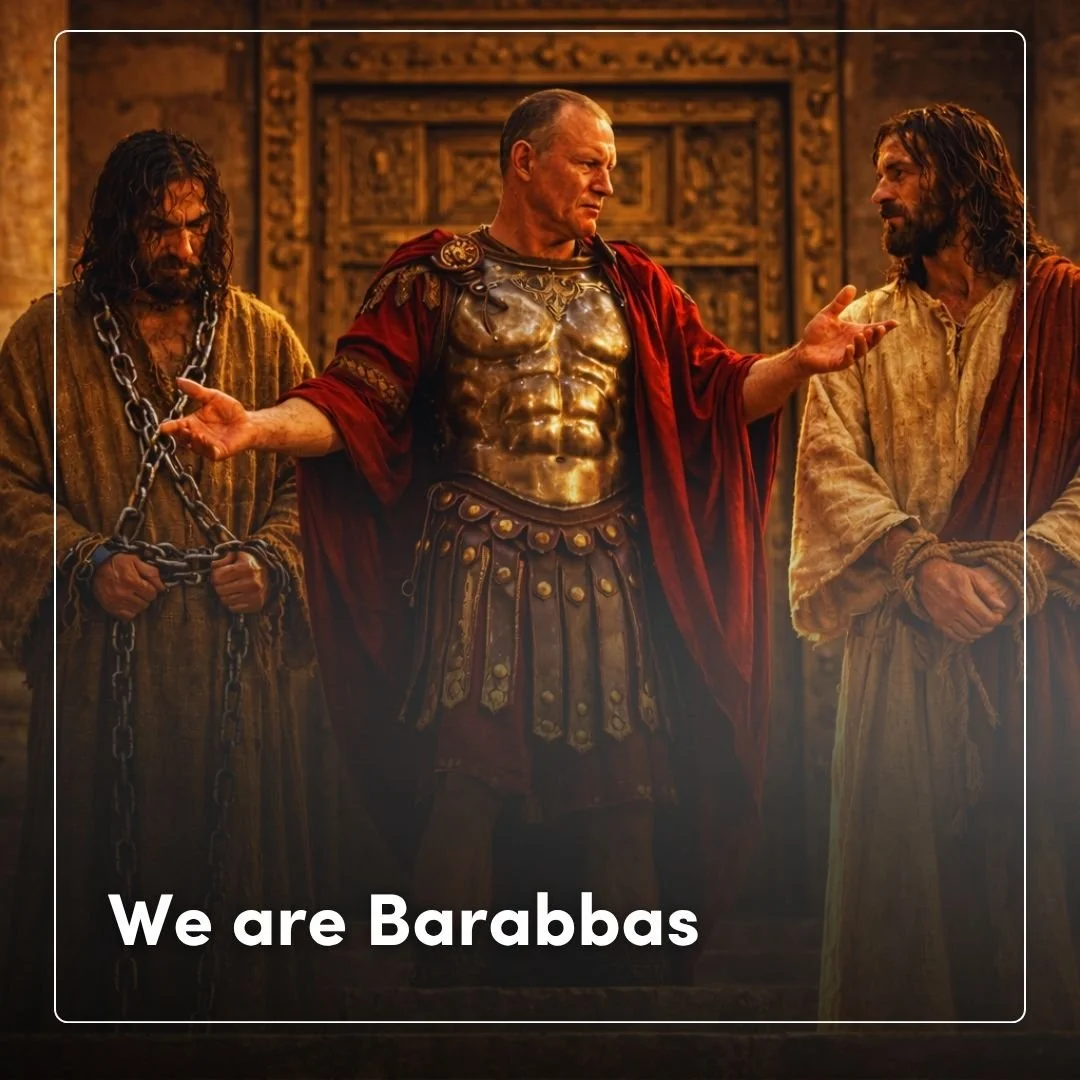
There’s a moment in the trial of Jesus that can feel almost rushed.
A name gets mentioned.
A crowd shouts.
A decision is made.
And just like that…one man walks free, and another is sent to the cross.
Barabbas.
Most people know the name, but very few stop and ask what just happened.
Because if you slow the story down, something begins to surface. This is not just a political decision. It is not just a crowd getting out of control.
It feels…familiar.
Like something Israel had seen before.
The trial
We come to a point in the life and ministry of Jesus where He is brought by the Jewish leadership to the Roman governor Pilate and He is on trial. And I would like to take the events that are before us and look at them within the context of a two act play. A theme that has been a very good servant of the ministry of The Jewish Road in illustrating the connection between the Old Testament and the New Testament (New Covenant) Scriptures. Put another way, the continuity between Jewish history and salvation history.
The trial of Jesus is covered in Matthew 27, Mark 15, and Luke 23. There is a connection between the trial that is laid out in the gospel accounts and the Old Testament Scripture in Leviticus 16:5-10, the offering of two identical goats on Yom Kippur (the Day of Atonement).
As we cover these events as recorded in the gospels and Leviticus there is an interesting paradox that we should take note of in both accounts and that we will uncover as we look at the relationship between these two events.
First, let us consider the trial of Jesus as He was before Pilate, during the time of Passover. Mark 15:1-15 gives a concise and excellent account of what took place at the trial. Pilate is the last in a long list of evil characters responsible for the murder of Jesus beginning with Judas and Annas and Caiaphas and Herod and now Pilate, the Roman governor.
However, divinely speaking, God is the true power and God is the true influence who brings His own Son to the cross. God, in reality, is the true executioner. He is the One who was pleased to kill His Son as a substitutionary sacrifice for our sins. The apostle Peter will give testimony to this in his great sermon on the Day of Pentecost as recorded in Acts 2:22-23, where he says,
“You crucified Him but by the determined counsel and foreknowledge of God.”
Again Peter, in Acts 4:27-28, makes the point that while there is human responsibility, God is the one who is accomplishing in the death of Jesus, His will and His saving purpose. Nevertheless, it is Pilate who gives the final sentence.
Jesus before Pilate or Pilate before Jesus?
This question leads us to a couple of paradoxical circumstances that come up during the trial of Jesus. First thing to recognize is this is all taking place during Passover. The lambs are going to be sacrificed in the Temple remembering what God did for the children of Israel in the exodus out of Egypt.
Here is the Messiah of Israel being accused by the Jewish leadership and put on trial by the Roman authorities. But the paradox lies in the truth of the matter that they are really the ones who are on trial. They are bringing judgment against Jesus, but in reality they are being judged by Jesus.
Judas, in the end, thought he sold out Jesus. But really Judas sold himself, not Jesus. The others, Annas and Caiaphas, and Herod all thought they sat in judgment on Jesus. But, in reality, He was their judge. This is the paradox. In all their judgments against Jesus, they were bringing condemnation upon themselves. They think that they are the judges, but Jesus is the true judge. And now we come to Pilate.
He is like a puppet because he is afraid of Rome and for his position. He is an accomplice with the people in order to protect his position. The sad part is he has no idea that he is on trial for his own life and his own career and his own eternal destiny as he stands before Jesus.
Let’s look at Mark 15:1-2:
“And as soon as it was morning, the chief priests held a consultation with the elders and scribes and the whole counsel. And they bound Jesus and they led him away and delivered him over to Pilate. 2 And Pilate asked him, “Are you the King of the Jews?” And he answered him, “You have said so.”
That was the last thing Jesus said. As Isaiah tells us 750 years earlier:“He was oppressed, and he was afflicted, yet he opened not his mouth; like a lamb that is led to the slaughter, and like a sheep that before its shearers is silent, so he opened not his mouth.” (Isaiah 53:7)
We should take note at this point that Pilate is actually pushing Jesus to defend himself, but in 15:5 it says:
“But Jesus made no further answer, so that Pilate was amazed.”
The chapter goes on to introduce us to yet another character in the story — Barabbas.
He is described as one of the rebels in prison who had committed murder in the insurrection. Now there was a tradition that the governor could release one prisoner for whom they asked (v.6). To get a full picture of what is taking place here in Act II we have to go back to Act I.
Barabbas and Jesus — two identical goats?
We find an interesting account related to this story of the trial of Jesus in the Book of Leviticus, chapter 16. We have been looking at events that are taking place during Passover. As we go back to the Book of Leviticus (Act I), we are transported to the activities of the High Priest on the Day of Atonement (Yom Kippur). How do these two connect?
In Leviticus 16, beginning in verse 5 the text tells us that the High Priest (Aaron) shall take two male goats for a sin offering. These would be identical goats. Verses 7-10:
7 “Then he shall take the two goats and set them before the Lord at the entrance of the tent of meeting. 8 And Aaron shall cast lots over the two goats, one lot for the Lord and the other lot for Azazel.
9 And Aaron shall present the goat on which the lot fell for the LORD and use it for a sin offering, 10 But the goat on which the lot fell for Azazel shall be presented alive before the LORD to make atonement over it, that it may be sent away into the wilderness to Azazel.
In other words, the lot that fell on the goat for the Lord, that goat would be taken as the one that would be killed (blood shed, Lev.17:11) as a sacrifice to “cover” sin. Remember, this is Yom Kippur, the holiest day on the Jewish calendar. “Kippur” means to cover, and that for one year until the next Yom Kippur. In other words, sin was covered not forgiven.
But the lot that fell on the goat for Azazel (scapegoat), that goat shall be presented alive before the Lord in recognition of the atonement being made for it by the first goat. And that goat is released.
What’s in a name?
There is something else about Barabbas that often goes unnoticed, and it adds another layer to this moment.
In some early manuscript traditions of Matthew’s Gospel, he is not simply called Barabbas, but “Yeshua (Jesus) Barabbas.” This reading appears in a small number of ancient sources, including the Codex Koridethi, a Greek manuscript of the Gospels dated to around the 9th century, along with a handful of other early textual witnesses.
Even earlier than that, the church father Origen (3rd century) noted that he had seen manuscripts with this exact reading. He also suggested that later scribes likely removed the name “Jesus” out of reverence, unwilling to associate it with a known criminal.
If that earlier reading reflects what stood in some of the earliest copies, then Pilate’s question becomes even more striking:
“Whom do you want me to release for you - Yeshua (Jesus) Barabbas, or Yeshua (Jesus) who is called the Messiah?” (Matthew 27:17)
Two men.
Same name.
And then there is the meaning of Barabbas itself.
Bar-Abba means “son of the father.”
So now the choice becomes even more precise:
One is a rebel.
One is righteous.
One is guilty.
One is innocent.
One is a “son of the father.”
The other is the Son of the Father.
And the crowd chooses.
Back to Mark’s gospel and the trial of Jesus. When the crowd came up to Pilate they asked him to follow the custom and release one of the prisoners. And Pilate asked in Mark 15:9:
“Do you want me to release for you the King of the Jews?”
The crowd was stirred up by the religious leaders demanding that he release Barrabas, to which Pilate responds in verse 12:
“Then what shall I do with the man you call the King of the Jews?”
And the crowd responds “Crucify him!” To which Pilate responds. “Why, what evil has he done?” Pilate wants to let Jesus go. He knows he is innocent, which was confirmed also by Herod (Luke 23:6-16). The crowd was getting too much for Pilate to reason with and so Pilate, fearing the crowd and his position with Rome, released Barrabas and delivered Jesus to be crucified (v.15).
Just as the Azazel (the scapegoat) in Leviticus was set free, now Barrabas is set free and Jesus goes to the cross as the sacrifice.
What is significant is to recognize that the guilty one is set free, that is you and me. We are Barrabas. With that in mind we should go back to Mark 15:12, because the question that Pilate asked the crowd is the ultimate question that every one of us has to answer:
What shall I do with Him whom you call the king of the Jews?
To bring it home to our present day and all that we see happening, we must realize that we are living in a world that is not going to repair itself. As we look at the chaos we ask, “Why is all of this happening?”
The question is a personal one, not a geopolitical one. The answer is love.
As we look back at the trial of Jesus and what followed, we see that love is a love that entered into history in a specific place, at a specific time. It is a love that did not float above the suffering but entered into it. A love that if the ancient Scriptures are to be believed, is not finished.
About The Jewish Road
At the heart of The Jewish Road lies a passion ignited by a father-son duo, Ron and Matt Davis. Our journey began with a simple yet profound desire: to bridge the gap in understanding that has kept two faith communities apart for too long. We're here to help Christians connect with the roots of their faith and for Jews to explore the life and teachings of Jesus with an open heart.
Imagine a world where every believer, be they Jewish or Christian, not only knows their faith but truly understands its origins and interconnectedness. We strive to restore the Jewish essence of the Gospel, offering insights that deepen knowledge, bolster faith, and propel the growth of the Kingdom. The narrative of faith, we believe, is a two-act play where both acts are essential for a comprehensive grasp of the story. By uniting these acts, we're presenting a more holistic and enriching perspective.
Life is too short to wander without knowing the full essence of your beliefs. Whether you're attending a synagogue or a church, there's so much more to discover. The Jewish Road is here to guide, enlighten, and, most importantly, bring both halves of the story together. Join us on this journey; together