Coming Down from the Mountaintop
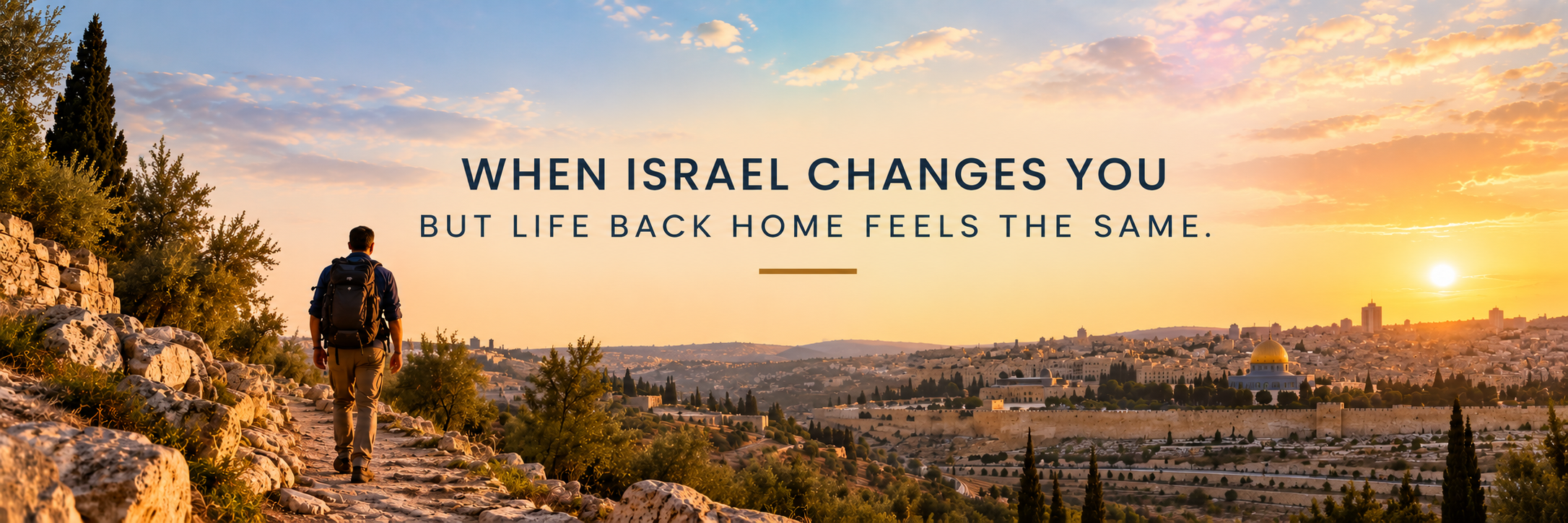
*This is written for those returning from Israel, or any retreat, camp, or experience where the Lord met you, and now you are living in the days after.
It's been a week since we returned from Israel, and by now most of us have settled back into our routines. The suitcases are unpacked, the laundry is done, the jet lag has finally worn off, and those hundreds of pictures we took are somewhere on our phones, waiting to be sorted.
For ten days, we were immersed in a world most Christians only read about. We walked through the wilderness, stood where David hid from Saul, opened Scripture along the Sea of Galilee, and approached Jerusalem with thousands of years of history beneath our feet. We prayed together, ate together, laughed a lot, and had conversations that will probably stay with us for the rest of our lives. Somewhere along the way, a group of travelers became a little family.
Then we came home. And maybe you're discovering that coming home is harder than you expected.
I've heard from people who miss Israel so much it almost hurts (my wife). They miss our group, the conversations, the teaching, and the sense that every day was filled with something meaningful. One friend described sitting on his porch with a cup of coffee, trying to process what had happened over there while staring at the ordinary responsibilities waiting for him here.
I understand that feeling. After years of traveling to Israel, I still experience some version of it.
But I suspect there's another layer to this for some of us.
Perhaps you expected your prayer life to be different after Israel. You thought opening your Bible would suddenly feel like stepping back into the places we visited. You hoped the clarity you experienced while walking through the land would follow you home. Maybe you prayed about surrendering something to God and imagined that trust would come a little easier when you returned.
And yet, here you are.
The same questions are waiting. The same work needs to be done. The same struggles still require attention. You may even feel a little disappointed in yourself because you had such an extraordinary experience and haven't figured out what to do with it.
If any of that sounds familiar, I've been thinking about someone in Scripture who might help us understand what happens after a mountaintop experience.
His name is Moses.
Moses Had to Come Down from Sinai
Exodus 34 records Moses descending Mount Sinai after forty days and nights in the presence of God. He has received the covenant tablets, encountered the glory of YHWH, and experienced the kind of intimacy with God that few people in Scripture ever knew.
When Moses returns, something remarkable has happened to his face.
Exodus 34:29 tells us that his skin was shining because he had been speaking with God. The Hebrew word is קָרַן — karan, describing rays of light radiating from his face.
And here's one of my favorite details: Moses didn't even know he was glowing.
Everyone else could see it. Aaron and the people were afraid to approach him, and Moses eventually began wearing a veil, removing it when he entered God's presence and when he communicated God's words to Israel. But consider what was waiting for him when he came down.
This wasn't Moses' first trip up Sinai. Israel had already broken the covenant through the golden calf. Moses had shattered the first tablets, interceded for the people, and returned to the mountain. Exodus 34 records the renewal of that covenant after a profound national failure.
And there, God reveals Himself to Moses as merciful and gracious, slow to anger, and abounding in steadfast love and faithfulness (Exodus 34:6). Moses comes down from the mountain carrying the words of a faithful God to a people who have already demonstrated how quickly they can wander.
There are still problems to solve, people to lead, and a nation that needs to learn how to live with the God who has redeemed them. The mountain was extraordinary. The wilderness was still the wilderness. And Moses had to lead them through it.
What happens when the glow begins to fade?
Paul reflects on Moses' shining face in 2 Corinthians 3. He contrasts the glory associated with the Sinai covenant with the surpassing and enduring glory of the new covenant through the Spirit.
Exodus doesn't tell us how quickly Moses' visible radiance faded. Paul's emphasis is theological, describing a glory that was passing away in comparison with the lasting ministry of the Spirit. Then he writes that we are being transformed into the Lord's image "from one degree of glory to another" (2 Corinthians 3:18).
Notice the language of transformation. It is ongoing.
We tend to expect significant encounters with God to produce immediate results. We want the old fears to disappear, the unresolved questions to settle, and the things we've struggled with for years to finally make sense.
But the Spirit's work in us often unfolds over time. Some changes are immediate and obvious. Others take root quietly and begin showing themselves through our choices, relationships, and growing understanding of God.
There's also a helpful insight from Jewish tradition. An ancient collection of Jewish teachings called Pirkei Avot, often translated as Ethics of the Fathers, opens by describing how Moses received the Torah at Mount Sinai and passed it on to Joshua, who passed it to the elders, and eventually through the generations.
The emphasis is on receiving something from God and carrying it forward. And that is especially meaningful when we consider how the book of Exodus ends. God's glory, once encountered by Moses on Sinai, eventually fills the Mishkan, the Tabernacle, in the middle of Israel's camp. The people continue their wilderness journey with God's presence among them.
They still have a long road ahead. But they have a faithful God who goes with them. That gives us a beautiful framework for what happens after Israel, or after any season when we've encountered God in a meaningful way. I'd hate to be formulaic, so this isn't a formula. Here are seven things I would encourage us to consider, and try one, or at least one at a time.
1. Give Yourself Permission to Miss It
There is a kind of grief that follows a beautiful experience, especially one shared with people you have grown to love. You miss the rhythms, the discoveries, the friendships, and the feeling of waking up each morning with something significant ahead.
You may even miss who you felt yourself becoming during those days.
The Psalms give us language for longing. Psalm 84 speaks of those whose hearts are set on the highways to Zion. Psalm 42 describes a soul thirsting for God as a deer longs for flowing streams. These are prayers from people who know what it means to desire God's presence deeply.
When you miss Israel, pay attention to what you're missing. Perhaps it's the closeness of the community, the time you spent in Scripture, or the opportunity to step away from the constant demands of life and focus on the things of God.
You can be grateful for an experience and still grieve its ending. Those feelings can exist together. Call someone from our group. Share a memory. Talk about a place that has stayed with you. Let yourself remember how much the experience meant. And give the emotions some room to settle.
2. Release the Expectations You Brought Home
I wonder how many of us returned with expectations we never quite put into words.
We thought prayer might feel more natural because we had prayed in Jerusalem. We expected the Bible to come alive every morning because we had walked through the places where its stories happened. Perhaps we imagined that the things we surrendered to God in the wilderness would finally stop troubling us when we got home.
And now we're wondering why some of those things still feel difficult. There is something worth remembering in the biblical account of Jacob.
In Genesis 32, Jacob wrestles through the night, receives a new name, Israel, and emerges from the encounter with God changed. Yet Genesis tells us that he also leaves limping. I love that picture. Jacob has encountered God, received a blessing, and gained a new identity. His body still carries the effects of the struggle.
Sometimes an encounter with God leaves us with greater faith and a clearer understanding of how much we still need Him. You may be reading the same Bible, but now you notice connections you missed before. You may still struggle to pray, but perhaps your prayers have become more honest. Your circumstances may be unchanged, while your understanding of God's faithfulness has begun to grow.
Allow yourself to discover what God is doing without imposing a deadline on the outcome.
3. Remember What God Showed You
When Israel crossed the Jordan River into the Promised Land, Joshua instructed twelve men to carry stones from the riverbed and establish a memorial. Joshua 4 explains that those stones would prompt future generations to ask what happened there.
The people would have a story to tell about God's faithfulness. We took thousands of pictures in Israel. But I wonder whether we have spent enough time asking what those pictures represent.
Choose three moments from our journey that continue to come to mind. Maybe it was standing in the wilderness, walking through the City of David, watching the sunrise over the Sea of Galilee, or hearing someone share their story of living in Israel today. Write down what you remember and why it affected you.
Was there a Scripture passage that made more sense? Did you recognize something about God's character? Was there a moment when you understood your own faith or the Jewish people differently?
During the trip, we encouraged everyone to find one thing each day worth carrying home. Now might be a good time to go back through those things. The memorial stones weren't meant to recreate the Jordan crossing. They helped Israel remember what God had done so the next generation could walk forward with confidence in His faithfulness.
4. Let the Land Keep Teaching You Through Scripture
One of the greatest gifts of traveling to Israel is the way the land changes our understanding of the Bible.
We've read about the Judean wilderness for years, but now we know what that landscape feels like. We've stood on the Mount of Olives and looked toward Jerusalem. We've seen how close some of the biblical locations really are and how much the geography shaped the events recorded in Scripture.
Those memories can continue enriching our study of God's Word. Choose a passage connected to one of the places we visited and return to it slowly. Read the surrounding chapters. Look for the Old Testament connections behind the words of Jesus. Ask where the passage fits in the larger storyline God has been telling through Israel.
Maybe the trip awakened something in you about Israel's continuing place in God's promises. Spend time in Romans 9–11. Perhaps the wilderness reminded you of your dependence on God. Revisit Deuteronomy 8.
And remember that Jesus Himself lived within the Jewish world we spent days exploring. The feasts, the Temple, the covenants, the land, and the Hebrew Scriptures were the world of His ministry.
You have been given context that can serve you for years. Let the experience deepen your study of Scripture, one passage at a time.
5. Find God in the Ordinary Places Waiting for You
Luke 9 describes another remarkable mountaintop experience.
Jesus takes Peter, James, and John up a mountain, where they witness His glory alongside Moses and Elijah. The disciples are overwhelmed, and Peter wants to build three tents.
He wants to stay. I can understand that. But Luke tells us that the next day they came down the mountain, and a father brought his suffering son to Jesus. The glory of the mountain was followed by a family in need. What a picture of the life of faith.
We spend days in Israel learning about God's faithfulness, and then we come home to spouses, children, neighbors, churches, colleagues, and people who need our attention. The very relationships and responsibilities waiting for us may become the places where God continues shaping what He began during the journey. Perhaps you return more patient with your family. Maybe you're quicker to pray for someone, more interested in hearing another person's story, or better equipped to explain a passage of Scripture.
Maybe there's someone you need to forgive or a conversation you've been avoiding. The next faithful step may be waiting in a place that looks completely ordinary. God was present on the mountain, and He was present when the disciples came down.
6. Stop Measuring Your Calling by What Happens Next
For some people, Israel awakens a strong desire to do something significant. You return with fresh ideas, renewed convictions, and prayers about what God might want from your life. Maybe you have ministry plans, a business, a book, a teaching opportunity, or something you've felt called to pursue.
Then you look at your calendar. The opportunities haven't arrived. The work feels uncertain. The old frustrations remain, and suddenly you begin questioning whether you're doing something wrong. I've spent enough years in ministry to understand how easily we can measure our faithfulness by the visible results of our efforts.
But the biblical story gives us a much longer view. Moses spent forty years in Midian before God called him back to Egypt. David was anointed king long before he occupied the throne. Joseph received dreams whose fulfillment required years of waiting, suffering, and circumstances he couldn't control.
God's faithfulness was at work throughout those seasons. That doesn't remove our responsibility to work, prepare, plan, and steward what He's given us. It means we can do those things while trusting Him with the results.
In John 21, Peter asks Jesus about another disciple's future. Jesus redirects the conversation toward Peter's own calling: "You follow me!" Maybe that's where we need to begin after Israel. What does following Jesus look like in the life I'm living today? That is a question worth asking even when the calendar is empty and the path forward isn't clear.
7. Pass Along What You've Received
Jewish tradition describes Moses receiving God's instruction at Sinai and passing it to Joshua, who carried it forward to the next generation. That same responsibility continued throughout Israel's history, as the words God gave to one generation were entrusted to the next.
Revelation was received and carried forward.
That is also what happened throughout Israel's history. Parents taught their children. Priests instructed the people. Prophets called Israel to remember the covenant. The story was passed from generation to generation.
And now, as followers of Jesus, we've been brought into that story through Israel's Messiah.
We have been given an opportunity to learn the Scriptures with their Jewish roots still attached, understand Israel's place in God's purposes, and carry that understanding into the lives of people around us.
Think about one person who might benefit from something you learned.
Perhaps someone in your church has questions about Israel. Maybe a friend has never considered the Jewish context of the Gospels. Perhaps a family member would enjoy hearing about one of the places we visited and how it changed the way you read a familiar passage.
Share the story with them. You don't need a platform, a podcast, or a teaching ministry to do that. A conversation around the dinner table can carry more meaning than we realize. And don't forget to keep praying for the people we met in Israel. Their lives continue in the land we have now left, and our relationships with them can become part of how we carry the journey forward.
What Moses Brought Down the Mountain
As I think about our days in Israel, I keep returning to Exodus 34 and the image of Moses coming down the mountain with his face shining.
He had encountered the presence of God in an extraordinary way. Yet the covenant he received was meant to shape a people living through the wilderness, raising families, settling disputes, learning to trust, and following God toward the land He had promised.
And that's how Exodus ends. The glory of God fills the Tabernacle, and the cloud of His presence accompanies Israel through their journeys. The same God Moses encountered on the mountain is now dwelling among His people as they continue down the road.
I find a lot of encouragement in that. We may have come home from Israel expecting everything to feel different. Perhaps some things do. Other things may take time, and we may still be carrying questions we hoped would have been answered by now.
The God who met us through His Word in Israel has accompanied us home. The same is true after a retreat, a season of solitude, a conference, or another meaningful spiritual encounter. The experience may end, while the work God began continues through the life waiting for us.
So give yourself some time. Miss Israel. Call your friends. Look through the pictures. Return to the Scriptures. Be honest about your hopes and the things you're still wrestling with.
And keep walking.
The glow may feel different down here, and that's okay. The transformation God is working in us has a much longer horizon than the days we spent together in Israel.
Perhaps one of the greatest gifts of an Israel trip is what begins to unfold after we come home.
With you on the road.
About The Jewish Road
At the heart of The Jewish Road lies a passion ignited by a father-son duo, Ron and Matt Davis. Our journey began with a simple yet profound desire: to bridge the gap in understanding that has kept two faith communities apart for too long. We're here to help Christians connect with the roots of their faith and for Jews to explore the life and teachings of Jesus with an open heart.
Imagine a world where every believer, be they Jewish or Christian, not only knows their faith but truly understands its origins and interconnectedness. We strive to restore the Jewish essence of the Gospel, offering insights that deepen knowledge, bolster faith, and propel the growth of the Kingdom. The narrative of faith, we believe, is a two-act play where both acts are essential for a comprehensive grasp of the story. By uniting these acts, we're presenting a more holistic and enriching perspective.
Life is too short to wander without knowing the full essence of your beliefs. Whether you're attending a synagogue or a church, there's so much more to discover. The Jewish Road is here to guide, enlighten, and, most importantly, bring both halves of the story together. Join us on this journey; together