Israel Is Voting. What Should Christians Understand?
Most of us have enough trouble keeping up with American politics. Then we turn on the news about Israel and hear about party lists, coalition negotiations, and somebody needing 61 seats.
And you thought a two-party system was difficult.
I’ve spent years studying Israel, teaching its story, and taking people there. But I’ll admit that its politics has often left me scratching my head. So, with Israelis heading to the polls, I did some homework to help all of us understand what we’re watching and how we might pray.
You don’t need to become an expert in Israeli politics. But understanding a few things can help you see the people and concerns behind the headlines.
First, how does someone actually win?
Israelis vote for a party list rather than directly choosing a prime minister. Those votes determine who fills the 120 seats in Israel’s parliament, the Knesset. Each list ranks its candidates beforehand, and seats are awarded roughly in proportion to its share of the qualifying vote. A list needs at least 3.25% of valid votes to enter parliament.
Sometimes parties run together on one list. That pools their support and helps explain why you might see two leaders’ names attached to the same choice.
Then comes the number everyone talks about: 61, a majority of the Knesset.
Parties negotiate to build a governing partnership, called a coalition. Israel’s president consults the parties and assigns a member of the Knesset the task of forming a government, which must win parliament’s confidence. Leading the largest party doesn’t automatically make someone prime minister. The ability to gather partners matters.
Imagine one party wins 30 seats but cannot find enough partners. Another wins 25 and assembles a coalition with 62. The leader of that smaller party could become prime minister.
So election night tells us how many seats each list has won. It may take weeks of negotiations to learn who can govern.
Why does Netanyahu keep coming up?
For many Americans, Benjamin Netanyahu is the only Israeli politician they can name. There’s a reason for that.
He has served as prime minister in three stretches: 1996–1999, 2009–June 2021, and again since December 2022. By October 2026, that adds up to roughly 19 years in office. His time in leadership has spanned much of a generation.
His supporters see an experienced leader who understands Israel’s enemies and can navigate dangerous times. His critics see a leader who has stayed too long and should be held accountable for what happened under his watch.
October 7 stands at the center of that debate. Hamas bears responsibility for carrying out the attack. Israelis also want answers about how their own government, military, and intelligence services failed to prevent it. Netanyahu has resisted demands for an independent state inquiry, while defending his subsequent military campaigns as necessary for Israel’s security.
For families who lost someone, survived an attack, or endured a loved one’s captivity, accountability is deeply personal.
Then there are the corruption cases, which predate October 7. Netanyahu was indicted in 2019, and his trial began in 2020. The charges include bribery, fraud, and breach of trust, involving allegations about expensive gifts and arrangements for favorable media coverage. He denies wrongdoing and has pleaded not guilty. His trial remains ongoing; allegations are not convictions.
Debates over his government’s efforts to change the judiciary have added another layer of distrust. Opponents fear weakened checks on government power. Together, these issues make this election about leadership, accountability, and whether Israelis trust the people making decisions for them.
Who are the other voices?
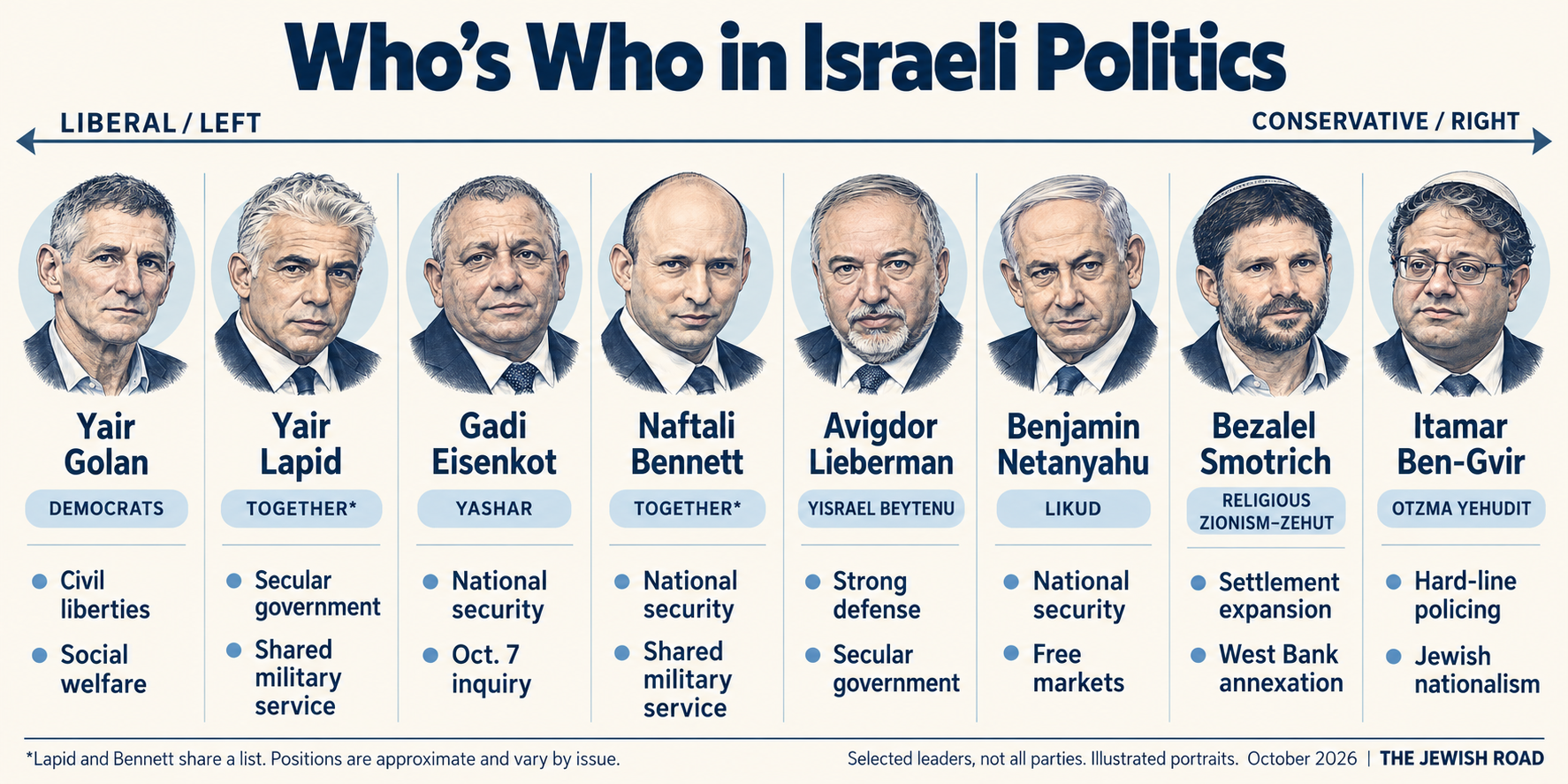
A few names help make the conversation easier to follow:
Gadi Eisenkot, Yashar: A former military chief whose campaign emphasizes security, accountability, and broader participation in military service.
Naftali Bennett and Yair Lapid, Together: Former prime ministers joining forces across right-wing and centrist backgrounds, with an emphasis on shared service and government reform.
Avigdor Lieberman, Yisrael Beytenu: A secular nationalist with strong security views who opposes religious coercion.
Yair Golan, Democrats: A leader on the political left who emphasizes democratic institutions, civil freedoms, and social support.
Bezalel Smotrich, Religious Zionism–Zehut, and Itamar Ben-Gvir, Otzma Yehudit: Separate leaders and lists on the far right, emphasizing Jewish nationalism, stronger Israeli control over the West Bank, also known as Judea and Samaria, and hard-line security policies.
Ultra-Orthodox parties and Arab-led parties also matter in the coalition arithmetic. Opposition to Netanyahu stretches across the political spectrum, so his opponents don’t necessarily agree with one another about what comes next.
Why is there so much tension over the ultra-Orthodox?
This is one of the hardest parts for outsiders to understand.
Israel is a Jewish state, but Jewish identity and religious practice aren’t the same thing. Israeli Jews include secular, traditional, religious, and ultra-Orthodox communities. Describing the country as “70% secular” blurs those differences, especially the many traditional Jews whose lives include meaningful religious observance.
The ultra-Orthodox, often called Haredim, accounted for about 14% of Israel’s total population in 2025. Their parties can have influence beyond their size because their seats may be essential to keeping a coalition in power.
Their ballots don’t count more than anyone else’s. But imagine you have 56 seats and need a party with seven seats to join you. That party now has a strong position at the negotiating table.
The deepest current tension concerns military service.
For decades, many Haredi men studying in religious schools received exemptions or deferments. Meanwhile, other Israelis served in the military and returned for reserve duty. In June 2024, Israel’s Supreme Court ruled that there was no legal basis for continuing the blanket exemption. Enforcement and efforts to preserve exemptions have remained fiercely contested.
Picture a parent whose child keeps returning to combat, or a reservist whose business is struggling because of repeated deployments. It’s easy to understand the question: Why does my family keep carrying this burden while another family is excused?
Many Haredim understand the issue differently. They believe Torah study helps sustain and protect the Jewish people, and they fear military life will pull young men away from their faith and community. Those convictions help explain their resistance, even when other Israelis strongly disagree.
Other disputes concern public funding, religious authority over marriage, and transportation on Shabbat. These are practical questions about who sets the rules for daily life.
So it’s too broad to say secular Israelis simply dislike Orthodox Jews. Much of the anger concerns unequal obligations and religious rules imposed through government. Nor are all Orthodox communities alike. Religious Zionists and Haredim have different relationships with military service and the state.
Understanding those distinctions helps us talk about real disagreements without reducing people to stereotypes.
The uncertainty feels familiar
Americans may not understand coalition negotiations, but we understand wondering what comes next.
We have our own elections, our own divisions, and our own questions about leadership. What happens with Iran? Will the war widen? What might that mean for our families, our economy, or someone we love in uniform?
Then there are the everyday concerns: gas, groceries, housing, and whether we can afford the next stage of life. Those prices have many causes, but uncertainty abroad adds to the questions we’re already carrying at home.
Our circumstances differ from those of Israeli families living with the direct costs of war. Still, that feeling of looking ahead and struggling to see clearly is familiar.
We’d all like someone to tell us exactly how this turns out.
An election can answer who holds office. It cannot settle every fear we carry.
God’s faithfulness isn’t on the ballot
For those of us who follow Jesus and care about Israel, this is where we need to keep our footing.
Our confidence in God’s faithfulness to His covenant with the Jewish people does not rest on the morality, capability, or culpability of an Israeli prime minister.
God is faithful despite human failure. Scripture gives us plenty of examples of that, including within Israel’s own leadership.
The prophets confronted Israel’s kings. They called out injustice and demanded repentance. Loving the people God loves has always left room for telling the truth about their leaders.
So we can support Israel’s right to exist, care deeply about the Jewish people, and still question a government’s decisions. We can seek accountability and grieve the suffering of Palestinian families. None of that requires us to abandon confidence in God’s promises.
We don’t have to align ourselves with every government policy. Our allegiance belongs to God and His purposes.
And last time I checked, His plan still included Israel. Romans 11:28–29 grounds that confidence in God’s enduring love and calling, rather than anyone’s political performance.
How do we pray?
Psalm 122:6 calls us to pray for Jerusalem’s peace, and 1 Timothy 2:1–2 calls us to pray for those in authority. We can begin there:
For wisdom and humility: Leaders who listen carefully, seek wise counsel, and put people ahead of personal ambition.
For truth and accountability: Honest examination of failures, fair legal proceedings, and the courage to act on what is learned.
For protection and healing: Grieving families, exhausted soldiers, frightened children, and Israeli and Palestinian civilians who long for safety.
For shared responsibility: A way through deep disagreements that honors both conscience and the obligations of living together.
For lasting peace: The kind that reaches homes, schools, neighborhoods, and the ordinary rhythms of life.
And as we pray, we remember where this story is going.
Isaiah 9:6 says of the coming Messiah, “the government shall be upon his shoulder.”
Ahhh. There’s the sigh of relief.
Isaiah also describes a day when weapons become tools for growing food and nations no longer train for war. That promise reaches far beyond a ceasefire or a successful election. It points us toward the reign of the Prince of Peace.
We aren’t there yet. Until that day, elections matter, leaders bear responsibility, and our neighbors need our prayers and care. But this uncertainty will not last forever. Whatever happens in Jerusalem or Washington, the shoulders that will finally carry the government belong to the One who can bear its weight.
About The Jewish Road
At the heart of The Jewish Road lies a passion ignited by a father-son duo, Ron and Matt Davis. Our journey began with a simple yet profound desire: to bridge the gap in understanding that has kept two faith communities apart for too long. We're here to help Christians connect with the roots of their faith and for Jews to explore the life and teachings of Jesus with an open heart.
Imagine a world where every believer, be they Jewish or Christian, not only knows their faith but truly understands its origins and interconnectedness. We strive to restore the Jewish essence of the Gospel, offering insights that deepen knowledge, bolster faith, and propel the growth of the Kingdom. The narrative of faith, we believe, is a two-act play where both acts are essential for a comprehensive grasp of the story. By uniting these acts, we're presenting a more holistic and enriching perspective.
Life is too short to wander without knowing the full essence of your beliefs. Whether you're attending a synagogue or a church, there's so much more to discover. The Jewish Road is here to guide, enlighten, and, most importantly, bring both halves of the story together. Join us on this journey; together