It Will Be Good, Again | Restoration through the lens of Tabernacles
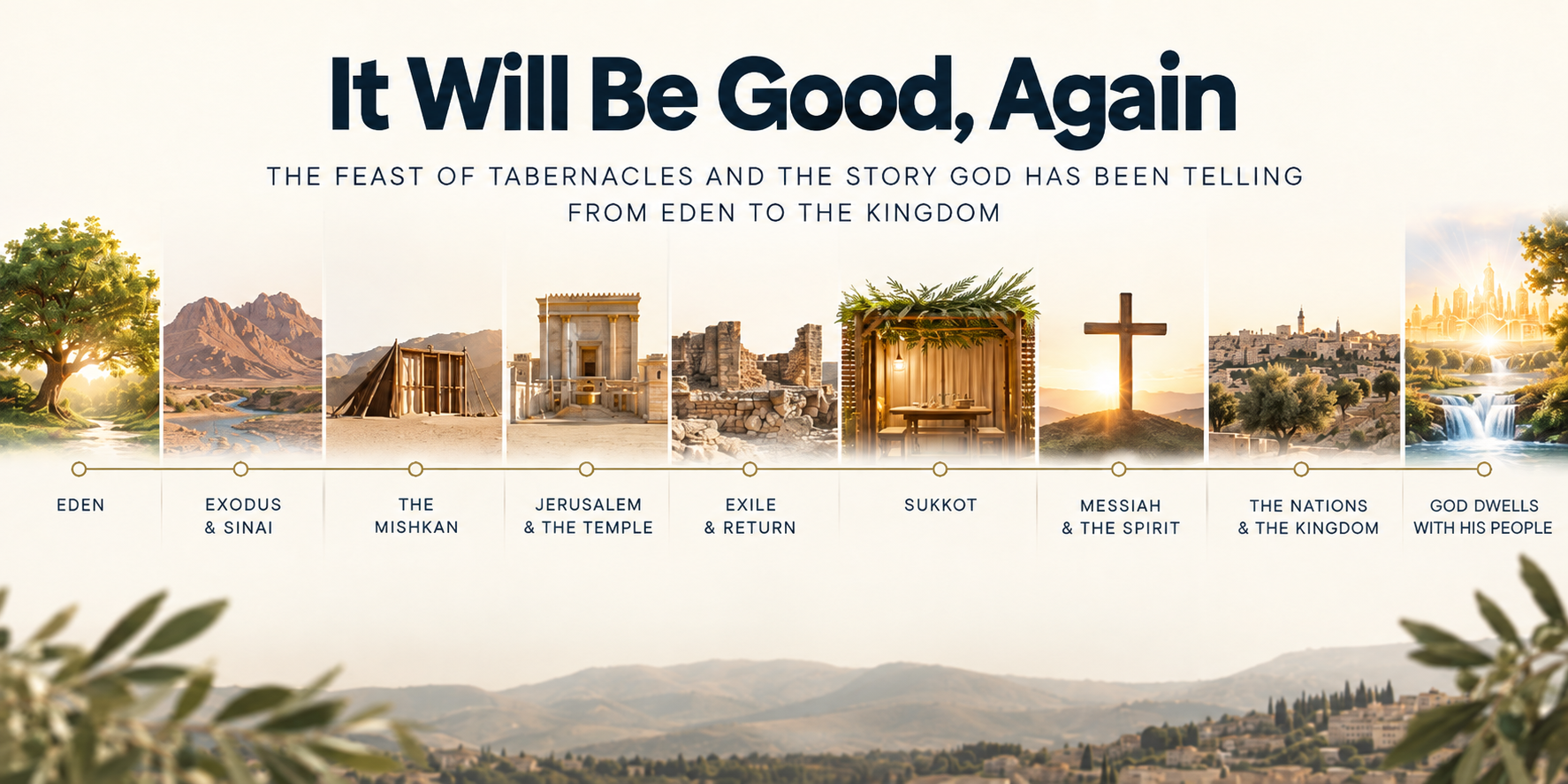
The Feast of Tabernacles and the Story God Has Been Telling from Eden to the Kingdom
Every fall, Jewish families build something intentionally temporary.
A sukkah, or booth, is sturdy enough to sit beneath and fragile enough to remind you that it won’t last. The roof is covered with palm branches and leafy boughs of trees. We invite family and friends to come over and share a meal together. For seven days, we leave our permanent houses and spend the holiday in a temporary shelter because God told Israel to remember what it was like to live in the wilderness under His care.
So you might be reading this thinking, “How in the world could this ancient Israeli feast talked about in the book of Leviticus of all books have any kind of relevance for me?” We get it, but invite you to read this in its entirety, because it’s a story you’ve been brought into as well.
The Feast of Tabernacles sits somewhere among many other apparent disconnected pieces of the Old Testament.
We know Israel wandered in the wilderness.
We have heard about the Tabernacle.
We know Jesus attended Jewish feasts.
We recognize palm branches from Palm Sunday.
We have read about living water, Peter wanting to build three tents at the Transfiguration, Ezekiel’s future Temple, and the nations gathering in Revelation.
All of those pieces may be familiar while the line connecting them remains hidden. Sukkot helps bring it all together.
The story begins before Abraham, Moses, or Israel existed. It begins in Eden, where God dwelled with humanity in a creation He pronounced טוֹב מְאֹד — tov me’od — “very good.”
The storyline of Sukkot is the storyline of God dwelling with His people.
And when the story reaches its destination, it will be tov me’od again.
From Eden to Exile
Genesis begins with a world ordered for life with God. Humanity bears His image and lives within His creation without Temple walls, priests, sacrifices, or sacred buildings separating holy space from ordinary space. Genesis 3:8 describes the LORD God “walking in the garden in the cool of the day.” Whatever questions we may ask about the precise nature of that encounter, the picture Genesis gives us is sure: humanity was created for life in the presence of God.
At the end of the creation account, God sees everything He has made and calls it tov me’od, very good. The Hebrew intensifier me’od pushes beyond ordinary goodness. Creation is functioning according to its intended order, with God, humanity, and the created world in proper relationship. Then the Fall fractures that order and we see the entrance of sin, shame, death, alienation, and finally exile east of Eden. Humanity loses the unhindered experience of the place where God’s presence and human life met.
That exile establishes a pattern Scripture will revisit more than once. Sin drives people from the place of blessing and presence, while redemption moves toward return, restoration, and renewed dwelling with God. The biblical story from Genesis 3 onward is therefore heading somewhere. God intends to deal with sin, restore what has been broken, and bring His creation toward the purpose for which He made it.
He begins that covenant work through a particular family and, eventually, a particular nation.
The Exodus and God Dwelling With Israel
We often tell the Exodus story as Israel getting out of Egypt. Scripture doesn’t top there. God brings Israel out of Egypt so He can bring Israel to Himself, establish covenant with them, and dwell in their midst.
At Sinai, God tells Moses, “Let them make me a sanctuary, that I may dwell in their midst” (Exodus 25:8, ESV). The Hebrew verb behind “dwell” is שָׁכַן — shakan, and from that root comes מִשְׁכָּן — Mishkan, the Tabernacle. The Mishkan is literally the dwelling place.
The book of Exodus begins with Pharaoh enslaving Israel and ends with the glory of YHWH filling the Tabernacle. That movement is the theological arc of the book. God rescues a people, brings them into covenant, gives them His instruction, and places His presence at the center of their camp. Exodus 29:45–46 expresses the purpose plainly: God will dwell among Israel, be their God, and remind them that He brought them out of Egypt so He could dwell among them.
The Exodus therefore becomes a kind of national creation story. Israel emerges through the waters, comes into covenant at Sinai, receives sacred space, and becomes the people among whom YHWH places His name.
Then God builds remembrance into Israel’s calendar.
Sukkot, An Appointment with God
Leviticus 23 calls Israel to keep the Feast of Booths beginning on the fifteenth day of the seventh month. The chapter introduces the feasts collectively as מוֹעֲדֵי יְהוָה — mo’adei YHWH, the appointed times of the LORD. A מוֹעֵד — moed is an appointed time, a set meeting. These days belong to God’s ordering of Israel’s life with Him.
For Sukkot, the instruction is unusually physical. Israel is to leave the security of permanent homes and live for seven days in temporary shelters. God explains why: future generations are to know that He made Israel dwell in booths when He brought them out of Egypt (Leviticus 23:42–43). The feast asks Israel to remember the wilderness with their bodies. You sit under branches. You feel the wind. You see the sky. You remember that the generation God redeemed from Egypt crossed a wilderness without cities, crops, walls, or permanent houses.
The sukkah teaches dependence without requiring a lecture on dependence. Israel is reminded year after year that her survival rested on the God who provided manna, water, Torah, and His own presence. Sukkot is also a harvest feast, called the Feast of Ingathering in Exodus. Think of it as the Jewish Thanksgiving. By the time it arrives, grain, wine, and produce have been gathered. Deuteronomy 16 repeatedly commands joy and widens the celebration to include everyone: sons and daughters, servants, Levites, sojourners, orphans, and widows. Israel remembers the days when she possessed almost nothing while celebrating the God who has now brought her into a fruitful land.
This is why Sukkot becomes so much larger than an autumn holiday. It rehearses the conviction that life with God is Israel’s true security.
From the Mishkan to the Temple
The next major movement takes the story from the wilderness to Jerusalem. First Kings 8 tells us that Solomon gathered Israel in the seventh month for the dedication of the Temple.
The symbolism is powerful. The Ark is carried into the Temple, the priests withdraw, and the cloud fills the house. First Kings says the priests could no longer stand to minister because “the glory of the LORD filled the house of the LORD” (1 Kings 8:11, ESV). Israel’s God, who had traveled with His people in the wilderness Mishkan, now places His name and glory in Jerusalem.
Solomon’s dedication prayer then opens the horizon beyond Israel. He asks God to hear the foreigner who comes from a distant country because that person has heard of YHWH’s great name. His prayer reaches toward the day when “all the peoples of the earth may know your name” (1 Kings 8:43, ESV). Israel’s election and the blessing of the nations are operating together. God chose Abraham with the nations in view, formed Israel with the nations in view, and placed His name in Jerusalem with the nations in view.
Sukkot therefore sits at an extraordinary intersection. The wilderness teaches Israel that God dwells with His covenant people and we see the Temple is the housing for that presence in Jerusalem. Solomon is looking forward and his prayer anticipates the nations being drawn toward Israel’s God.
Then Israel’s sin brings another exile.
Ezekiel: “Then They Will Know” Becomes “The LORD Is There”
Ezekiel sees the catastrophe unfold in theological terms. Jerusalem falls, the Temple is defiled, and the glory of YHWH departs. Ezekiel 10–11 traces that departure in stages until the glory moves east of the city. The movement recalls Eden again: sin has driven God’s covenant people from the place associated with His presence. Are we catching the repetition?
One of Ezekiel’s signature phrases is “then they will know that I am the LORD.” John T. Strong notes that some form of the phrase appears about 77 times in Ezekiel, with the basic form: subject + “will know that I am YHWH” - appearing 59 times. Other scholars count the variations somewhat differently, yet all agree that this refrain saturates the book.
But why so much emphasis on knowing?
Because exile has raised the deepest covenant questions. Does YHWH still rule? Have Babylon’s gods won? Has Israel’s God abandoned His promises? Through judgment and restoration, YHWH will make His name known. Ezekiel 36 brings this directly into Israel’s future: God will vindicate His holy name, gather Israel from the nations, bring them into their own land, sprinkle clean water on them, give them a new heart, and put His Spirit within them. Ezekiel 37 continues the movement through the valley of dry bones. Israel, described as dead and without hope, is raised and restored. The chapter moves toward covenant language: God will set His sanctuary among them, His dwelling place will be with them, He will be their God, and they will be His people.
Then Ezekiel 40 begins a long vision of future sanctuary, land, worship, and divine order. The book’s relentless “they will know” formula gives way to an extended picture of what restored presence looks like. Ezekiel 43 sees the glory return from the east - the same direction in which it had departed. Ezekiel 47 sees water flowing from the sanctuary, growing from ankle-deep to knee-deep to a river too deep to cross. Wherever it goes, life follows. Trees grow on its banks, fruit appears continually, and leaves are given for healing.
The book finally ends with the restored city measured and named. Ezekiel 48:35 gives the final words:
יְהוָה שָׁמָּה — YHWH Shammah — “The LORD Is There.”
The recognition formula has reached its destination in presence. Israel will know. The nations will know. THE GLORY RETURNS! The city’s very name announces the outcome:
The LORD is there.
That phrase gives us the theological heart of restoration: God dwelling with His people again.
Israel Builds Booths Again
Check out this progression:
The exile ends in stages.
Jewish exiles return from Babylon.
The Temple is rebuilt.
Jerusalem is repopulated.
Torah is publicly read again.
Nehemiah 8 places Sukkot directly into that restoration setting. Ezra reads the Torah before the assembled people, and they discover the instruction to dwell in booths during the seventh month. Families gather branches and construct sukkot on rooftops, in courtyards, and in the public spaces of Jerusalem. The chapter says the celebration produced “very great rejoicing” (Nehemiah 8:17, ESV).
This is covenant memory after exile. Israel is back in the land, listening to Torah and living inside a feast that remembers an earlier journey from exile into inheritance. For those returned exiles, the wilderness story could hardly have felt remote. Their ancestors had been brought out of Egypt and now their own generation had been brought out of Babylon. Both stories testified to the faithfulness of the same covenant God.
Then we cross into what we like to call Act II, the New Testament, where the Gospel of John opens with Tabernacle language.
“The Word Became Flesh and Tabernacled Among Us”
John 1:14 is one of the richest sentences in the New Testament:
“And the Word became flesh and dwelt among us, and we have seen his glory.”
— John 1:14, ESV
The Greek verb translated “dwelt” is ἐσκήνωσεν — eskēnōsen, from the family of words associated with tents, tabernacles, and dwelling. By the New Testament period the verb could simply mean “dwell,” yet interpreters across the spectrum have recognized John’s deliberate use of Tabernacle imagery because he immediately pairs dwelling with glory. The wording evokes the glory of YHWH filling the Mishkan in Exodus 40 and the Temple in 1 Kings 8.
John is now telling Israel’s story through Jesus.
The presence once associated with tent, cloud, fire, and Temple has drawn near in the person of Messiah. John’s Gospel will continue developing that idea through Jesus’ body as Temple, His presence among Israel, His teaching during the feasts, and the promise of the Spirit.
For Christians, this is where the fragmented pieces begin to lock together. The Incarnation belongs inside the story God has already been telling through Israel. Jesus enters a Jewish world where all of these familiar pieces of their own story live. John wants us to hear those echoes when he says the Word “dwelt” among us.
Then John takes us directly to Sukkot.
Living Water at the Feast
John 7 begins by identifying the setting: “the Jews’ Feast of Booths was at hand” (John 7:2, ESV). The feast frames the entire chapter forcing us to call to memory everything we have just read. As you read this next part, read it as if you were a first-century Jew following Jesus. Jesus goes up to Jerusalem, teaches in the Temple, engages the crowds and leaders, and then stands on the final and climactic day to make one of His boldest public declarations.
By the Second Temple period, Sukkot had developed a famous water-libation ceremony. Jewish sources describe water being drawn from the Pool of Siloam in a golden vessel and carried in procession to the Temple, accompanied by trumpet blasts and celebration. The water was poured at the altar, and Isaiah 12:3 - “with joy you will draw water from the wells of salvation” - became associated with the ceremony.
That setting is the backdrop soundtrack that makes John 7:37–39 take on new shape:
“If anyone thirsts, let him come to me and drink.”
— John 7:37, ESV
John then explains that Jesus was speaking about the Spirit.
The biblical connections accumulate. Israel received water in the wilderness. Isaiah spoke of drawing water from the wells of salvation. Ezekiel saw a river flowing from the restored sanctuary. Ezekiel 36 had already joined cleansing water with the gift of God’s Spirit. Zechariah would later describe living waters flowing from Jerusalem when YHWH becomes King over all the earth.
Jesus stands in the middle of Sukkot and declares that the living water Israel longs for is bound up with Him and the coming Spirit.
The archaeology of ancient Jerusalem adds physical texture to the story. The Pool of Siloam stood below the Temple complex, and the monumental stepped street commonly called the Pilgrimage Road connected the area of the pool with the ascent toward the Temple. We cannot establish the exact spot from which Jesus spoke in John 7, yet the Gospel places Him in the Temple world of Sukkot, while the water rite itself moved from Siloam toward the Temple. The geography reinforces the theological movement: water below, procession upward, Temple above, and Jesus announcing the Spirit in the middle of the feast.
Palm Branches, Hosanna, and Jewish Expectation
Leviticus 23:40 commands Israel to take branches during Sukkot and rejoice before YHWH. Over time the lulav, especially the palm branch, became one of Sukkot’s most recognizable symbols. Psalm 118 also became embedded in festival worship, giving Israel the cry הוֹשִׁיעָה נָּא — hoshiah na, “save us, please” - the expression that comes into English as Hosanna.
When Jesus enters Jerusalem in John 12, the crowds take palm branches and cry, “Hosanna! Blessed is he who comes in the name of the Lord, even the King of Israel!” The historical event occurs at Passover. Palm branches had become associated with deliverance, hope, and the presence of God among His people. The crowd’s actions are communicating more than excitement. They are greeting a king and are reaching for the language Israel uses when longing for salvation.
For the Jewish Road, one interpretive shorthand helps hold the symbol together:
When you see the palms, think: God with His people.
The crowd believes the Kingdom is arriving. Jesus truly is Israel’s King, but in this first appearing, the route to the Kingdom will pass through His suffering first as the Lamb.
Peter Reaches for Tents
The Transfiguration gives us another echo of this dwelling theology. On its own, it’s confusing. Jesus goes up a mountain with Peter, James, and John. His appearance changes, what we know as the Transfiguration. Moses and Elijah appear and a bright cloud overshadows the scene, and the Father speaks.
Peter responds in a thoroughly Jewish way: “I will make three tents here” (Matthew 17:4, ESV).
The text never assigns the Transfiguration to the Feast of Sukkot, so what is Peter doing? Peter sees Moses (Law) and Elijah (Prophets) standing with Jesus in glory and reaches for the language of dwelling. Let’s set up a tent, we have the presence! He is witnessing a preview of the Kingdom.
Sukkot is already associated with the hope of God dwelling among His people, and the prophets will eventually connect the feast explicitly to the coming reign of the King. Peter’s impulse fits within that Jewish expectation even as the Father directs attention toward the Son: “This is my beloved Son. . .listen to him.”
The presence of God and the Kingdom of God center in Messiah.
Israel Remains Israel
At this point, the storyline requires clarity because Scripture itself requires clarity. God has not rejected Israel. Paul raises the question in Romans 11 and answers it categorically: “By no means!” (Romans 11:1, ESV).
Gentile followers of Jesus have been grafted into the cultivated olive tree. They share the nourishing root and participate in blessings flowing through Israel’s Messiah. Paul instructs those Gentiles to remember the direction of the graft: “It is not you who support the root, but the root that supports you” (Romans 11:18, ESV).
The Church does not erase Israel’s identity, cancel the covenants, or transfer Israel’s promises away from the Jewish people. Paul grounds his confidence in the character and calling of God, concluding that “the gifts and the calling of God are irrevocable” (Romans 11:29, ESV). Gentile inclusion demonstrates the reach of God’s promise to Abraham, through whom all the families of the earth would be blessed. Israel’s future restoration demonstrates the faithfulness of the same covenant-making God.
This is directly relevant if you are a Christian reading Sukkot. You have been welcomed into a story whose roots preceded us. Israel’s Scriptures are your Scriptures. Israel’s Messiah is our Messiah. Israel’s God has become known among the nations. The future presented by the prophets includes restored Israel and gathered nations worshiping the same King.
Zechariah gives us the clearest Sukkot picture of that future.
The King Reigns From Jerusalem
Zechariah 14 describes a future day in which YHWH intervenes, His kingship is openly established, and Jerusalem becomes the focal point of a transformed world. Verse 9 declares, “the LORD will be king over all the earth” (ESV). Earlier in the chapter, living water flows out from Jerusalem, extending east and west.
Then comes a statement that will unfortunately surprise a lot of Christians when they get to those kingdom days:
The nations will go up year after year “to worship the King, the LORD of hosts, and to keep the Feast of Booths.”
— Zechariah 14:16, ESV
This is the same feast that began with Israel sitting under temporary branches and remembering the wilderness. And who is celebrating it? The nations, not just the Jews. The nations are coming to Jerusalem.
This fulfills the trajectory we saw in Solomon’s prayer. God establishes His presence among Israel, and the nations come to know His name. Israel’s election has accomplished its outward purpose without dissolving Israel’s covenant identity. The nations worship with restored Israel under the reign of Israel’s King.
Sukkot has become a Kingdom feast. Its great themes have matured: harvest, joy, ingathering, Jerusalem, living water, divine presence, Israel, and the nations. Then Revelation picks up the imagery.
All Nations Before the Lamb, with Palm Branches
Revelation 7 gives John a vision of an innumerable multitude from “every nation, from all tribes and peoples and languages” standing before God’s throne and before the Lamb (Revelation 7:9, ESV).
They are wearing white. They are worshiping. And guess what they are holding: palm branches.
Scholars have long noticed strong Sukkot imagery in this scene. The palms, the great gathered multitude, the language of divine sheltering later in the chapter, and the feast’s association with eschatological ingathering form a compelling cluster. Revelation 7:15 goes even deeper to the connection further. The One seated on the throne will shelter them with His presence. The Greek verb belongs to the same skēnē/skēnoō word family that John used in John 1:14 for the Word dwelling among us.
Then the Lamb leads them to springs of living water.
Palms.
Nations.
The Lamb.
Tabernacling presence.
Living water.
The symbols we have followed from Torah through the Prophets and the Gospel of John are arriving together.
The Dwelling Place of God Is With Man
Revelation 21 finally states the destination plainly:
“Behold, the dwelling place of God is with man.”
— Revelation 21:3, ESV
John uses the language of the tabernacle again. The story that began in Genesis with humanity in God’s presence has reached restoration. God dwells with His people. Death is removed. Tears are wiped away. The former order has passed.
Then Revelation 22 takes us into a garden-city filled with echoes of both Eden and Ezekiel. The river of the water of life flows from the throne of God and of the Lamb. The tree of life grows again, producing fruit, and its leaves are “for the healing of the nations” (Revelation 22:2, ESV).
Ezekiel’s river has reached its destination.
Eden’s tree has returned.
Zechariah’s nations are there.
The curse is gone.
God’s servants see His face.
The story has come full circle.
It Will Be Tov Me’od, Again
This is why the Feast of Tabernacles belongs in the Christian imagination. It’s beautiful. It’s not just ours. It’s not just yours. It’s ours. We. . .WE. . .will be together in His presence.
Sukkot gives us one of Scripture’s clearest throughlines for understanding what God is doing from Genesis to Revelation. It begins with the presence for which humanity was created. It passes through Israel because God chose a people, redeemed them, covenanted with them, and placed His presence in their midst. They experience His presence through wilderness booths, Temple worship, exile, return, and the annual rhythm of God’s appointed times.
Then Messiah enters Israel’s story.
The Word tabernacles among His people.
Jesus stands at Sukkot and promises living water through the Holy Spirit.
Palm branches surround the King.
Peter sees glory and reaches instinctively for tents.
Paul declares that God remains faithful to Israel and that Gentiles have been grafted into the covenant story.
The prophets then carry us toward the destination: Israel restored, the King reigning from Jerusalem, the nations coming up to worship, living water flowing, and Sukkot celebrated in the Kingdom.
Revelation gathers the symbols one final time. The nations stand before the Lamb, with palms. God shelters them with His presence. Living water flows. The tree of life bears fruit. The curse disappears.
And God dwells with His people. The Bible begins with tov me’od. It ends with restoration.
Sukkot stands in the middle of the story every year and reminds Israel - and the Christians who have been grafted into this story - where everything is going.
The LORD is there.
And when He dwells with His people again, it will be tov me’od.
It will be good, again.
About The Jewish Road
At the heart of The Jewish Road lies a passion ignited by a father-son duo, Ron and Matt Davis. Our journey began with a simple yet profound desire: to bridge the gap in understanding that has kept two faith communities apart for too long. We're here to help Christians connect with the roots of their faith and for Jews to explore the life and teachings of Jesus with an open heart.
Imagine a world where every believer, be they Jewish or Christian, not only knows their faith but truly understands its origins and interconnectedness. We strive to restore the Jewish essence of the Gospel, offering insights that deepen knowledge, bolster faith, and propel the growth of the Kingdom. The narrative of faith, we believe, is a two-act play where both acts are essential for a comprehensive grasp of the story. By uniting these acts, we're presenting a more holistic and enriching perspective.
Life is too short to wander without knowing the full essence of your beliefs. Whether you're attending a synagogue or a church, there's so much more to discover. The Jewish Road is here to guide, enlighten, and, most importantly, bring both halves of the story together. Join us on this journey; together