Tisha b’Av and the Tipping Point Before Us
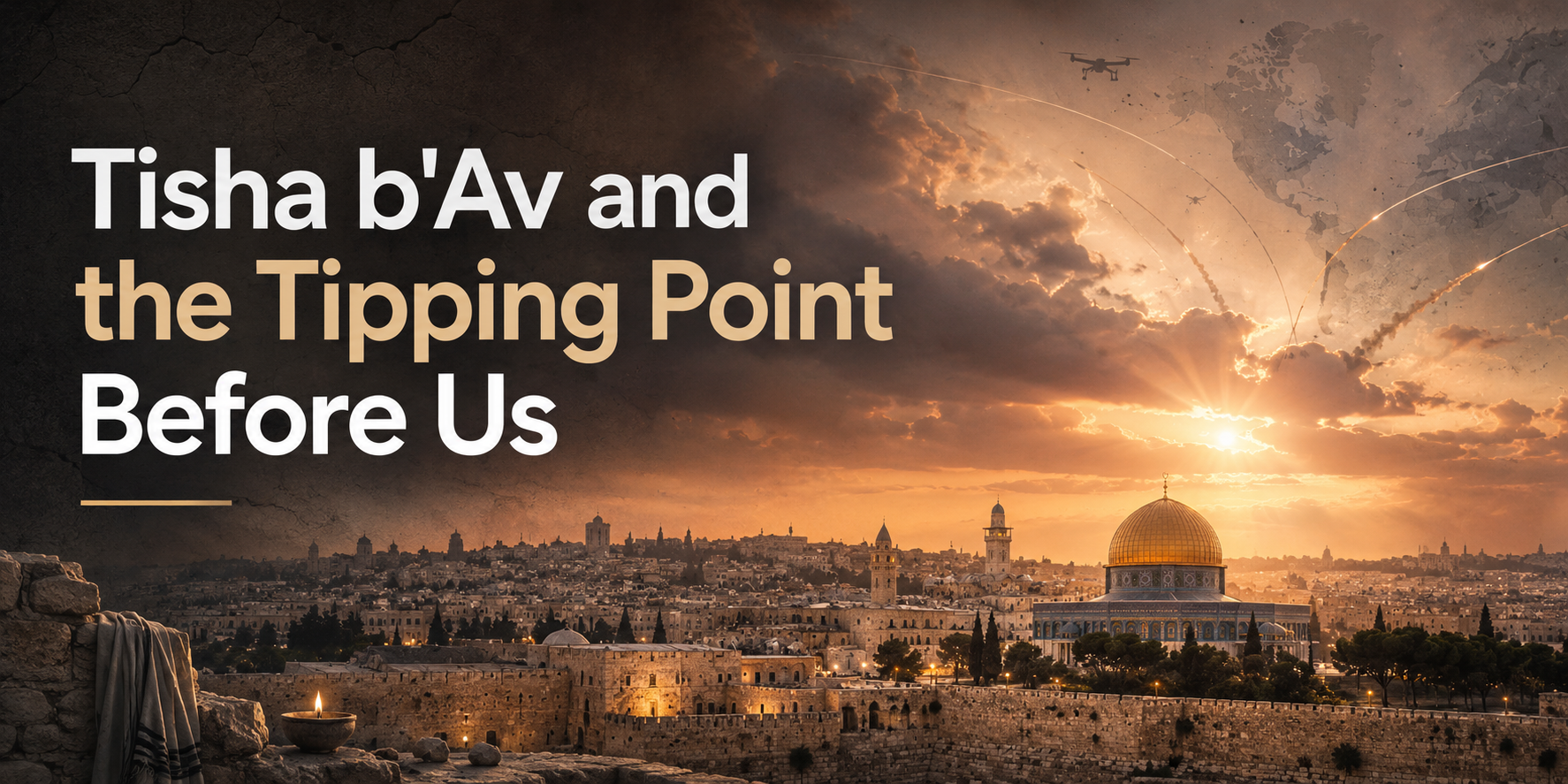
This week was Tisha b’Av, the ninth day of the Hebrew month of Av. For the Jewish people, it is a day of fasting, mourning, and remembrance. It remembers many wounds in Israel’s history, but above all, it remembers the destruction of the First and Second Temples in Jerusalem. The First Temple was destroyed by Babylon. The Second Temple was destroyed by Rome. Centuries apart, both destructions having taken place on the same date, the ninth of Av on the Jewish calendar. And we remember.
A Day for Remembering Destruction
For Christians, this can sound like distant history. We know the Temple mattered. We know Jerusalem mattered. We know Jesus taught in its courts and wept over the city. But because we live so far removed from the world of temple worship, we can miss what the loss truly meant.
The Temple was not just a building. It was the center of Jewish worship, national life, priestly service, sacrifice, memory, and longing. It was the place where the people of Israel came before the God of Israel. So when the Temple fell, it was not just stone that came down. An entire Jewish world collapsed with it.
That is why Tisha b’Av matters. It teaches Israel how to remember destruction without surrendering the story. It trains the Jewish people to look evil in the face and say, “You have not erased us.” Empires have tried. Armies have marched. Synagogues and cities have been attacked and burned. Mass graves have been filled. Jewish families have been slandered and driven into the diaspora.
And yet, the Jewish people remain. And that is because God is faithful to His promises: “For I am the Lord, I do not change; therefore you are not consumed, O sons of Jacob” (Malachi 3:6).
But Tisha b’Av also forces us to see a pattern we may not want to see. The same evil that wanted Israel destroyed in the past is still at work today. We should be careful here. Babylon is not Rome. Rome is not Nazi Germany. Nazi Germany is not Hamas. Hamas is not Hezbollah. Hezbollah is not Iran. However, there is a thread running through all of this. And history is warning us. There is a hatred that keeps returning to the Jewish people, their land, their calling, and their God.
The names change. The spirit does not.
Same Hatred, New Weapons
In our own day, the weapons have also changed. The ancient world had siege ramps, swords, and fire. Today, Israel faces rockets, drones, terror tunnels, cyber warfare, propaganda, and global pressure. The battlefield is no longer only a border or a city gate. It is the sky above Israel, the screens in our hands, the halls of government, the campus quad, shipping lanes, the banking system, and the narrative being written in real time.
For those of us paying attention, this moment feels like a tipping point.
There is a larger warning that should not be missed. The prophets spoke of things to come and over a fourth of the Bible is prophecy that is meant to prepare us for the things to come. As it has been said, Bible prophecy is not meant “to scare us, but to prepare us.” Fear makes people frantic. Preparation makes people faithful.
We must look at the world through the lens of Scripture, not so Christians become wild-eyed and anxious, but so we do not become naïve. The world is shifting fast. The Middle East is not a side story. It is once again at the center of world events. And at the center of that is Israel.
Israel is powerful to defend itself when attacked. However, there are limits to Israel's military prowess. When Israel fights, it must be swift and effective. Israel has its limitations and it cannot prosecute a long and protracted war. That is not hard to understand. Israel is small. Its margin for error is small. Its enemies often have depth, distance, proxies, and time. Israel does not have the luxury of pretending threats will go away if it waits long enough.
And that brings up another question. What about America’s role? “The United States has been holding Israel back from doing what it wants to do.” That is a serious claim, and one that should be handled with care. There may be strategic reasons for restraint. There may be reasons the United States believes it is preventing a wider war. But from Israel’s perspective, the question is painfully simple: how long can a nation wait while its enemies regroup?
A Pause Is Not Peace
That question becomes even more serious when we talk about Iran. There was a recent Memorandum of Understanding (MOU), which is not peace but simply an agreement to talk about peace. That distinction is important because talking is not peace. A pause is not peace. A ceasefire is not shalom. The Bible’s vision of peace is not evil taking a breath before it reloads. Shalom is wholeness, truth, safety, and life ordered under God.
This is where many in the West may be misreading the moment. We like deals because deals let leaders announce progress. We like pauses because pauses lower the temperature. We like signed papers because they make chaos feel managed. But if a pause gives evil time to rebuild, then we should be careful what we call peace.
Islam has a word that they present when they call for a cease fire. That word is “hudna.” When they are losing the battle they call for hudna, which is simply the idea of a pause or cease fire. It looks like progress toward peace, but it is simply used as a time to regroup and build up their military for battle. They say peace while they rearm for war. Again, that is the kind of claim that should be weighed carefully. But the moral question behind it is unavoidable. Can evil be negotiated with, or must it be defeated? Can a regime that funds terror, crushes its own people, threatens Israel, and uses proxy armies across the region be trusted simply because it signs an agreement to talk?
Tisha b’Av would tell us to be careful.
The Jewish people have a long memory because they have had to. They know what happens when the world hears threats against Jews and assumes it is just rhetoric. They know what happens when leaders mistake exhaustion for peace. They know what happens when evil is treated as manageable until the smoke rises.
And this is where Americans need to wake up.
The enemies of Israel are rarely enemies of Israel only. The same voices that cry “death to Israel” often cry “death to America” in the next breath. Israel may be the first target because Israel stands at the center of the covenant story, but Israel is not the final target. The hatred aimed at Jerusalem does not stay neatly inside the Middle East.
Here is a warning that should cause us to sit up and think. America may not be as secure as we assume. Weapons are being developed with the rise of drone and missile systems, China’s involvement with Iran, and the concern that American systems like Patriot and THAAD (Terminal High Altitude Area Defense) may not be enough against the next generation of threats. With China’s BeiDou (Navigation Satellite System) comes a warning that we may be entering a new kind of battlefield where the tools America has relied on for decades are being challenged.
Some of those details will need to be sorted out by military experts. But the larger point is clear enough: we are not living in a world where America can simply assume it will always be untouchable. Technology is moving. Alliances are shifting. Iran is not isolated in the way many would like to think. China needs influence. Russia wants leverage. Terror groups want survival. And Israel is standing in the middle of a story much larger than its borders.
How Christians Should Stand in This Moment
So what do we do with all of this?
First, we remember. Tisha b’Av reminds us that destruction is real, and Jewish suffering is not an abstraction. When the Temple fell, real people mourned. When Jewish communities were attacked across the centuries, real families carried the cost. When Israel is threatened today, real mothers put children in safe rooms. Real soldiers stand guard. Real families wait for hostages and Jewish communities wonder if the world is listening.
Second, we discern. We do not panic. We do not chase every rumor. We do not turn every headline into a prophecy chart. But we also do not close our eyes. Jesus rebuked people who could read the weather but not the times. We should know the difference between peace and delay, between restraint and weakness, between compassion and confusion.
Third, we pray. We pray for Israel and the Jewish people. We pray for the IDF. We pray for the Church to stand with clarity and humility. We pray for America to have wisdom and courage. We pray for the Iranian people, many of whom suffer under the same regime that threatens Israel. We pray for doors of the gospel to open in places that seem closed.
Consider what might happen if the Persian people rose up, if the regime fell, and if the doors opened for the gospel to go into Iran. It is already happening as the underground church has been consistently growing over the last decade. Persia has been part of God’s story before. Daniel lived there. Esther lived under Persian rule. Cyrus was used by God to help the Jewish people return from exile. God has not forgotten the Persian people either.
That is why our response cannot be fear, but faithfulness. Walter Breuggeman speaks to the seasons of the soul, from orientation to disorientation to reorientation:
"What is promised in this covenant is not equilibrium but faithfulness. The Bible is realistic in knowing that life does not consist in pleasant growth to well-being, but it consists in painful wrenchings and surprising gifts. And over none of them do we preside."
This story is not moving to how things used to be, but a new normal, the restoration of all things. Tisha b’Av is a day of mourning, but it is not a day without hope. The Temple was destroyed, but God was not defeated. Jerusalem burned, but the promises were not canceled. The people were scattered, but not erased. The enemies celebrated, but they did not get the final word.
They never do.
We may be standing at a tipping point. The story is moving. The nations are shifting. Israel is being pressed. America is being tested. The Church is being asked whether we will sleep, speculate, or stand.
So we remember the ashes.
We watch the horizon.
We pray for the peace of Jerusalem.
And we trust the God of Israel, who has never once failed to keep His word.
About The Jewish Road
At the heart of The Jewish Road lies a passion ignited by a father-son duo, Ron and Matt Davis. Our journey began with a simple yet profound desire: to bridge the gap in understanding that has kept two faith communities apart for too long. We're here to help Christians connect with the roots of their faith and for Jews to explore the life and teachings of Jesus with an open heart.
Imagine a world where every believer, be they Jewish or Christian, not only knows their faith but truly understands its origins and interconnectedness. We strive to restore the Jewish essence of the Gospel, offering insights that deepen knowledge, bolster faith, and propel the growth of the Kingdom. The narrative of faith, we believe, is a two-act play where both acts are essential for a comprehensive grasp of the story. By uniting these acts, we're presenting a more holistic and enriching perspective.
Life is too short to wander without knowing the full essence of your beliefs. Whether you're attending a synagogue or a church, there's so much more to discover. The Jewish Road is here to guide, enlighten, and, most importantly, bring both halves of the story together. Join us on this journey; together