A Memorandum Is Not Shalom
This morning, I watched a video that bothered me more than I expected. You can watch it here…
At a World Cup match in Los Angeles between Iran and New Zealand, stadium staff reportedly removed an Israeli flag from a fan while Palestinian flags nearby were left alone.
The reason given was “safety.” That word caught me.
Safety for whom?
Because if the flag of the Jewish state is treated as the threat, while the hatred of the Jewish state is treated as normal, then we are not just dealing with stadium policy. We are looking at something deeper.
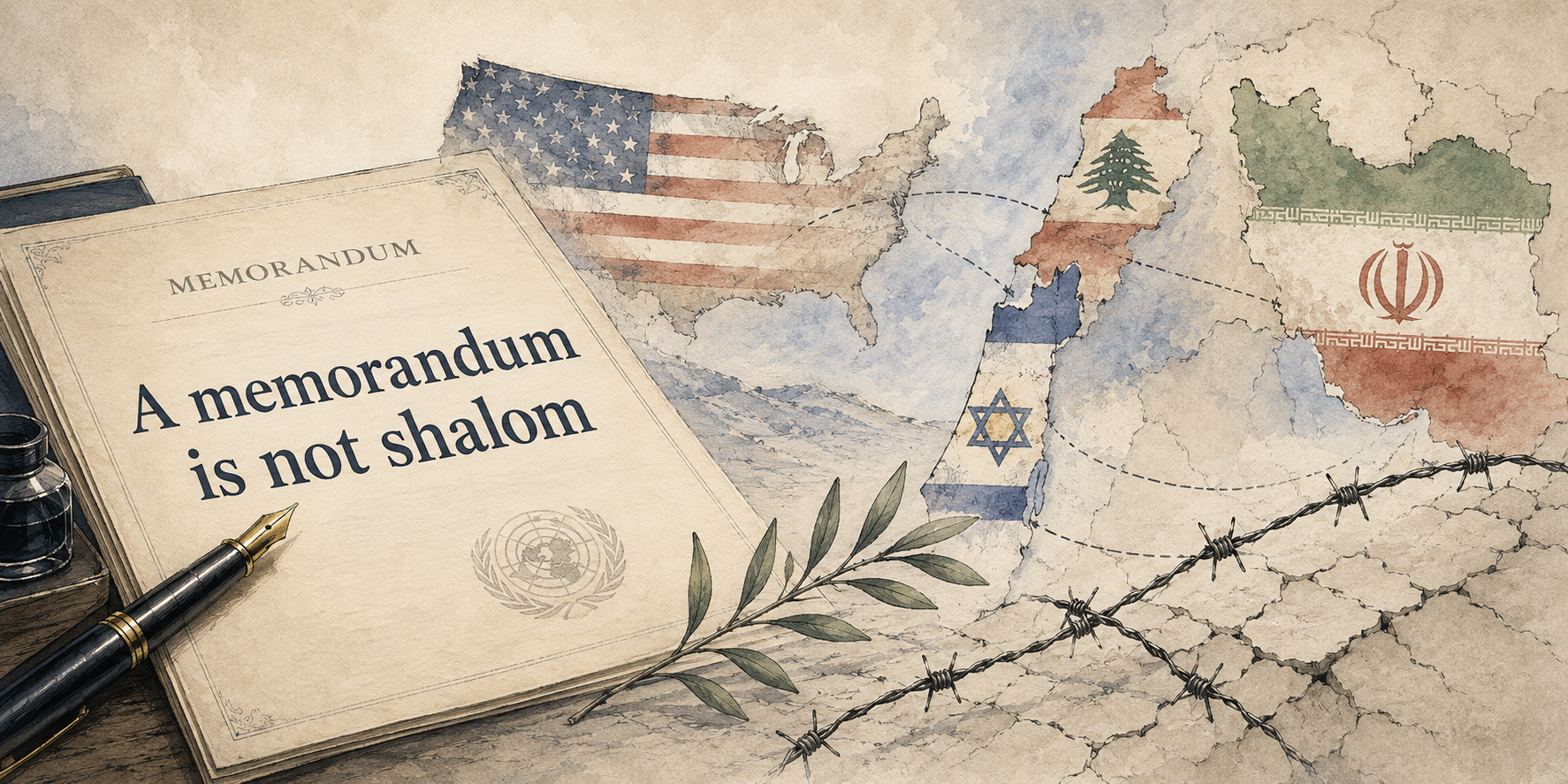
And that is where this recent memorandum of understanding between the United States and Iran has to be understood.
Not just politically. Theologically.
The Jewish Road is not a political organization. We are not here to tell Christians which party to trust, which candidate to defend, or which administration to blame.
But we are theo-political.
By that we mean this: we are watching the nations, listening to the headlines, reading the Scriptures, and asking a better question.
What is God showing us?
On paper, the MOU is being presented as a path toward peace. It pauses military operations. It opens a window for negotiation. It keeps oil moving. It gives world leaders something they can point to and say, “We are making progress.”
And to be clear, we want peace. Also to be clear, we haven’t seen the memorandum and we don’t have the privilege of insider information. We simply are paying attention to what all the parties are saying and trying to make sense of it all, as are you.
We pray for peace. We long for peace. We are not cheering for war. We are not hoping for more bloodshed. We do not want Israeli families running to bomb shelters. We do not want Jewish children growing up with the sound of sirens as normal life. We do not want innocent Persians crushed under the weight of a regime many of them do not support.
But the Bible does not let us confuse quiet with peace.
The Hebrew word shalom is not a temporary pause in violence. It is wholeness. It is safety. It is truth ordered rightly. It is enemies laying down weapons, not simply waiting for the next opportunity to pick them back up.
This is a significant moment.
Because if a deal brings temporary calm while allowing Iran’s terror network to rebuild, rearm, and regroup, then we should be careful about calling it peace.
Hezbollah is not a normal political neighbor on Israel’s northern border. It is an Iranian-backed terror army that has spent years turning southern Lebanon into a launchpad against Israel. Israeli families in the north know this personally. They are not talking about theories. They are talking about rockets, drones, tunnels, invasion plans, destroyed homes, and children who cannot safely return to their own bedrooms.
That is the part many Western observers miss.
For Americans, Lebanon can sound like a line item in a foreign policy agreement. For Israelis, it is the fence line.
It is Metula. It is Kiryat Shmona. It is the Galilee. It is the place where Jewish families are asking if anyone in the world understands what happened on October 7, and what almost happened on a larger scale in the north.
This is why Israel is pushing back.
The concern is not simply that Iran will sign a bad document. The concern is that Iran understands time. Authoritarian regimes often think in decades. Democracies think in election cycles, gas prices, budget pressures, and news cycles.
America, like every nation, is shaped by the limits and pressures of human leadership.
And it reminds us of something Scripture has been saying for a long time: do not put your ultimate trust in princes.
Allies matter. Treaties matter. Diplomacy matters. But none of them are God.
America can be a friend to Israel, and we pray it will be. Presidents can make wise decisions, and we pray they do. Negotiators can buy time, slow escalation, and keep a war from spreading, and when that happens, we should be grateful.
But Christians should never confuse American foreign policy with the covenant faithfulness of God.
That is where this becomes theological.
God made promises to Israel before there was a United States of America. He bound Himself to Abraham, Isaac, and Jacob before there were modern maps, modern borders, and modern governments. The Jewish people are not still here because nations have always protected them. They are still here because God keeps His word.
This does not mean every decision of the modern State of Israel is perfect.
It does not mean Christians should turn off discernment.
It does not mean we cannot grieve civilian suffering in Lebanon, Iran, Gaza, or anywhere else.
It means we refuse to treat Israel as just another disposable bargaining chip in the story of the nations.
The Jewish people carry a story God began. The land of Israel carries a story God named. Jerusalem carries a story God has not forgotten.
And when the world asks Israel to trade security for signatures, Christians should at least have the courage to ask hard questions.
Will this agreement actually restrain Iran, or simply give it time?
Will Hezbollah be dismantled, or be allowed to rebuild underground?
Will Israel be expected to absorb threats that no other nation would be asked to tolerate?
Will the world call it “peace” while Jewish families remain exposed?
The Psalmist cries out in Psalm 120 from the distress of living among those who hate peace: “Too long have I lived among those who hate peace. I am for peace; but when I speak, they are for war” (Psalm 120:6–7). The context is not a rejection of peace, but the lament of someone who genuinely desires it while surrounded by people determined to pursue conflict. It is a biblical category that reminds us words can sound peaceful while intentions remain hostile.
Words can soothe.
Paper can reassure.
Ceremonies can look impressive.
But the test of peace is not the signing table. The test of peace is whether evil is restrained, truth is honored, and the vulnerable are protected.
So what is God up to in this?
Maybe He is reminding the Church to stop being naïve.
Maybe He is exposing how quickly the nations shift when money, oil, power, and pressure are on the table.
Maybe He is teaching us that supporting Israel is not sentimental. It is costly. It requires prayer, clarity, courage, and a willingness to stand with the Jewish people when the headlines get complicated.
Maybe He is also reminding us to pray for the Persian people, many of whom are not the regime. Many long for freedom. Many have suffered under the same powers that threaten Israel.
And maybe He is reminding us that the isolation of Israel is not a surprise to anyone who has been reading the Scriptures.
We do not need to turn every headline into a prophecy chart. We do not need to force every event into a timeline. But we should be honest enough to see the pattern.
The prophets told us Jerusalem would become a cup of trembling to the nations. Jesus told us hatred would come against those connected to His name and His purposes. Paul reminded us that the gifts and calling of God toward Israel are irrevocable.
So when an Israeli flag becomes the problem in a stadium, and Israel’s security becomes a bargaining chip in a diplomatic agreement, Christians should not look away.
This is not new. It is ancient.
The people of the covenant have been hated before. They are hated again. And yet, we remain.
That is not because the nations are faithful. It is because God is.
So we pray for real peace.
We pray for wisdom for America’s leaders.
We pray for courage and restraint for Israel’s leaders.
We pray for the people of Lebanon who have suffered under Hezbollah’s grip.
We pray for the people of Iran who long to be free from the Islamic regime.
And we pray for the peace of Jerusalem.
But we do not pray with our eyes closed.
We watch. We discern. We remember the story. And we refuse to call something shalom until it bears the fruit of shalom.
A memorandum may pause a war. A stadium may remove a flag. The nations may shift with pressure, oil, elections, and fear.
But the God of Abraham, Isaac, and Jacob has not shifted. And only He can bring true peace.
About The Jewish Road
At the heart of The Jewish Road lies a passion ignited by a father-son duo, Ron and Matt Davis. Our journey began with a simple yet profound desire: to bridge the gap in understanding that has kept two faith communities apart for too long. We're here to help Christians connect with the roots of their faith and for Jews to explore the life and teachings of Jesus with an open heart.
Imagine a world where every believer, be they Jewish or Christian, not only knows their faith but truly understands its origins and interconnectedness. We strive to restore the Jewish essence of the Gospel, offering insights that deepen knowledge, bolster faith, and propel the growth of the Kingdom. The narrative of faith, we believe, is a two-act play where both acts are essential for a comprehensive grasp of the story. By uniting these acts, we're presenting a more holistic and enriching perspective.
Life is too short to wander without knowing the full essence of your beliefs. Whether you're attending a synagogue or a church, there's so much more to discover. The Jewish Road is here to guide, enlighten, and, most importantly, bring both halves of the story together. Join us on this journey; together