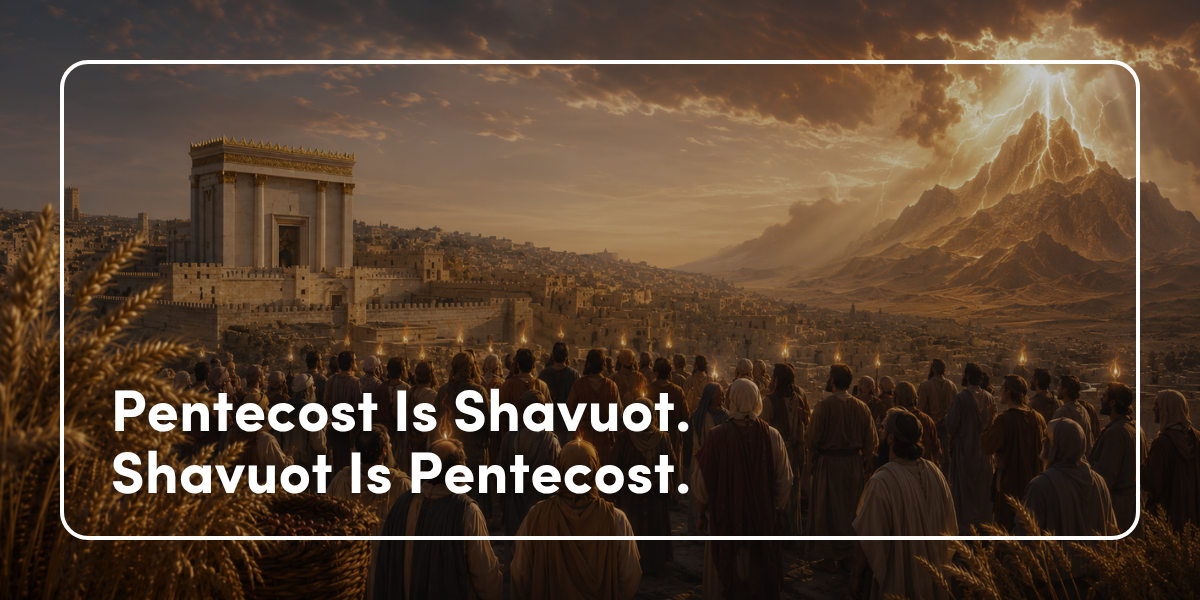
Pentecost Is Shavuot. Shavuot Is Pentecost.
There are two friends talking on the phone. One is Jewish, and the other is Christian. They want to get together and grab coffee.
The Jewish friend says, “Great, let’s do Sunday.”
The Christian friend says, “I can’t. It’s Pentecost. Let’s do Friday.”
The Jewish friend says, “I can’t. It’s Shavuot.”
And neither one realizes they are talking about the same day.
That little conversation says a lot about the disconnect between Jews and Christians. We often use different words, follow different calendars, and celebrate different traditions. But underneath those differences is a shared biblical foundation, and in this case, both friends are standing on the same appointed time of God.
Pentecost is the Feast of Weeks, which in Hebrew is Shavuot. Shavuot is Pentecost. And it carries very significant meaning for both Christians and Jews.
Shavuot means “weeks.” Pentecost comes from the Greek word pentekoste, meaning “fiftieth.” This appointed day occurs fifty days after the Sabbath following Passover. Leviticus 23 gives Israel the command to count seven full weeks and then present a new grain offering to the Lord:
“You shall count seven full weeks from the day after the Sabbath… You shall count fifty days to the day after the seventh Sabbath. Then you shall present a grain offering of new grain to the LORD.” Leviticus 23:15–16
So when Christians read Acts 2 and see “the day of Pentecost,” we need to understand that this was not a new Christian holiday. It was Shavuot. It was a Jewish feast day. Jerusalem was filled with Jewish pilgrims from across the world who had come to worship the God of Israel at one of His appointed times.
That means the birth of the church did not happen on a random day. It happened on Shavuot, in Jerusalem, among Jewish people, in fulfillment of the Jewish Scriptures.
Sinai and Jerusalem
For Jewish people, Shavuot is traditionally connected to the giving of the Torah at Mount Sinai. After God delivered Israel out of Egyptian bondage and slavery, He brought them to the mountain. Moses went up, and the voice of God thundered from the mountain with trumpets, smoke, lightning, and fire. Exodus 19 describes it this way:
“On the morning of the third day there were thunders and lightnings and a thick cloud on the mountain and a very loud trumpet blast… Now Mount Sinai was wrapped in smoke because the LORD had descended on it in fire.” Exodus 19:16, 18
The whole mountain quaked, and the people trembled. God was giving His covenant to His people.
But while Moses was on the mountain receiving the tablets of the Law, the people grew impatient. They thought Moses was gone so long that perhaps he would not return. So they made a golden calf and worshiped it. When Moses came down and saw the calf and the people dancing, judgment followed. Exodus 32 says:
“And the sons of Levi did according to the word of Moses. And that day about three thousand men of the people fell.” Exodus 32:28
On that day, connected with the giving of the Law, 3,000 died.
Now fast forward about 1,500 years.
On that same appointed day, Shavuot, after the resurrection of Messiah Jesus, something amazing happened in Jerusalem. Acts 2 tells us that they were all together in one place. And we need to remember who “they” were. They were Jewish followers of Jesus, gathered in Jerusalem on a Jewish feast day.
“And suddenly there came from heaven a sound like a mighty rushing wind, and it filled the entire house where they were sitting. And divided tongues as of fire appeared to them and rested on each one of them.” Acts 2:2–3
Once again, there is sound from heaven. Once again, there is fire. Once again, God is speaking.
But this time, the Word of God is not being written on tablets of stone. It is being written on human hearts by the Spirit of God. This is exactly what the prophets had promised:
“And I will give you a new heart, and a new spirit I will put within you…And I will put my Spirit within you, and cause you to walk in my statutes.” Ezekiel 36:26–27
The connection is hard to miss. At Sinai, the Law was given and 3,000 died. In Jerusalem, on Pentecost, the Spirit was given and 3,000 were saved.
“So those who received his word were baptized, and there were added that day about three thousand souls.” Acts 2:41
This is not a disconnected New Testament event. It is the fulfillment of Shavuot. The God who thundered from Sinai is the same God who poured out His Spirit in Jerusalem. The same God who gave His Word to Israel now writes His Word on the hearts of His people.
As Paul would later say, “The letter kills, but the Spirit gives life” (2 Corinthians 3:6).
The First Believers Were Jewish
There is another important detail Christians often miss. The first believers were Jewish.
Peter was Jewish. The apostles were Jewish. The crowd in Acts 2 was made up of Jews and proselytes from the nations who had come to Jerusalem for the feast. The church began as a Jewish movement centered on the Jewish Messiah, in the Jewish capital, on a Jewish feast day, in fulfillment of Jewish Scripture.
That matters.
Later, in Acts 10, the Gentiles come into the picture in a major way through Peter’s preaching to Cornelius and his household. But the beginning of this story is Jewish from top to bottom.
Even the early numbers show the harvest beginning among the Jewish people. Acts 2 tells us 3,000 were added. Later, after Peter and John preach again, Acts 4 says:
“But many of those who had heard the word believed, and the number of the men came to about five thousand.” Acts 4:4
So now we have thousands of new believers in Messiah. And they are Jewish.
This all begins in fulfillment of the Feast of Shavuot, which is a harvest feast.
The Firstfruits Harvest
Shavuot is a firstfruits celebration. In fact, it is connected to the second firstfruits offering on Israel’s calendar.
The first firstfruits offering comes in the early spring, right after Passover and the Feast of Unleavened Bread. As the crops begin to rise out of the ground, Israel was commanded to bring a sheaf of the firstfruits of the harvest to the priest, and he would wave it before the Lord.
“When you come into the land that I give you and reap its harvest, you shall bring the sheaf of the firstfruits of your harvest to the priest.” Leviticus 23:10
This was a way of thanking the Lord that the first of the harvest had come up from the ground, with the expectation that a greater harvest was still to come.
In its fulfillment, this points to the resurrection of Messiah. Paul says:
“But in fact Messiah has been raised from the dead, the firstfruits of those who have fallen asleep.” 1 Corinthians 15:20
Messiah is the firstfruits from the dead. He rises first, and His resurrection promises that more resurrection is coming. He is first, and then the rest of the harvest follows.
Fifty days later, at Shavuot, Israel was to bring another offering from the wheat harvest. This was also a firstfruits offering, looking forward to a greater harvest still to come. Leviticus 23 gives us a fascinating detail:
“You shall bring from your dwelling places two loaves of bread to be waved, made of two tenths of an ephah. They shall be of fine flour, and they shall be baked with leaven, as firstfruits to the LORD.”
Leviticus 23:17
Two loaves. Same weight. Presented before the Lord. And they are made with leaven.
That should get our attention, because leaven in Scripture often represents sin or corruption. Yet here, in this offering, leaven is included. Why? Because this harvest is made up of people who are redeemed, but not yet perfected.
Jew and Gentile together. One body in Messiah. Still being sanctified. Still waiting for the fullness of redemption.
Paul writes in Ephesians 2 that Messiah “has made us both one” and has created “one new man” in Himself, making peace (Ephesians 2:14–15). Shavuot was looking forward to this great harvest, Jews and Gentiles brought together in Messiah as one body, sent into the world as witnesses.
The Fields Are Still White
Jesus said in John 4:35:
“Look, I tell you, lift up your eyes, and see that the fields are white for harvest.”
That is the time we are living in now.
The spring feasts have been fulfilled in Messiah’s first coming. Passover points to His death. Unleavened Bread points to His sinless body. Firstfruits points to His resurrection. Shavuot points to the giving of the Spirit and the first great harvest of Jewish believers in Jerusalem.
The fall feasts still point us forward. Trumpets, Yom Kippur, and Sukkot carry the hope of repentance, atonement, kingdom, and God dwelling with His people in fullness.
So we live in the interval between the spring and the fall. Between fulfillment and fullness. Between the firstfruits and the final harvest. This is the age of the church, made up of Jews and Gentiles in Messiah. And we are the ones sent into the harvest.
As we often say at The Jewish Road, this is a time for us to be a light, be a voice, and be a blessing until His return.
Chag Shavuot Sameach.
About The Jewish Road
At the heart of The Jewish Road lies a passion ignited by a father-son duo, Ron and Matt Davis. Our journey began with a simple yet profound desire: to bridge the gap in understanding that has kept two faith communities apart for too long. We're here to help Christians connect with the roots of their faith and for Jews to explore the life and teachings of Jesus with an open heart.
Imagine a world where every believer, be they Jewish or Christian, not only knows their faith but truly understands its origins and interconnectedness. We strive to restore the Jewish essence of the Gospel, offering insights that deepen knowledge, bolster faith, and propel the growth of the Kingdom. The narrative of faith, we believe, is a two-act play where both acts are essential for a comprehensive grasp of the story. By uniting these acts, we're presenting a more holistic and enriching perspective.
Life is too short to wander without knowing the full essence of your beliefs. Whether you're attending a synagogue or a church, there's so much more to discover. The Jewish Road is here to guide, enlighten, and, most importantly, bring both halves of the story together. Join us on this journey; together