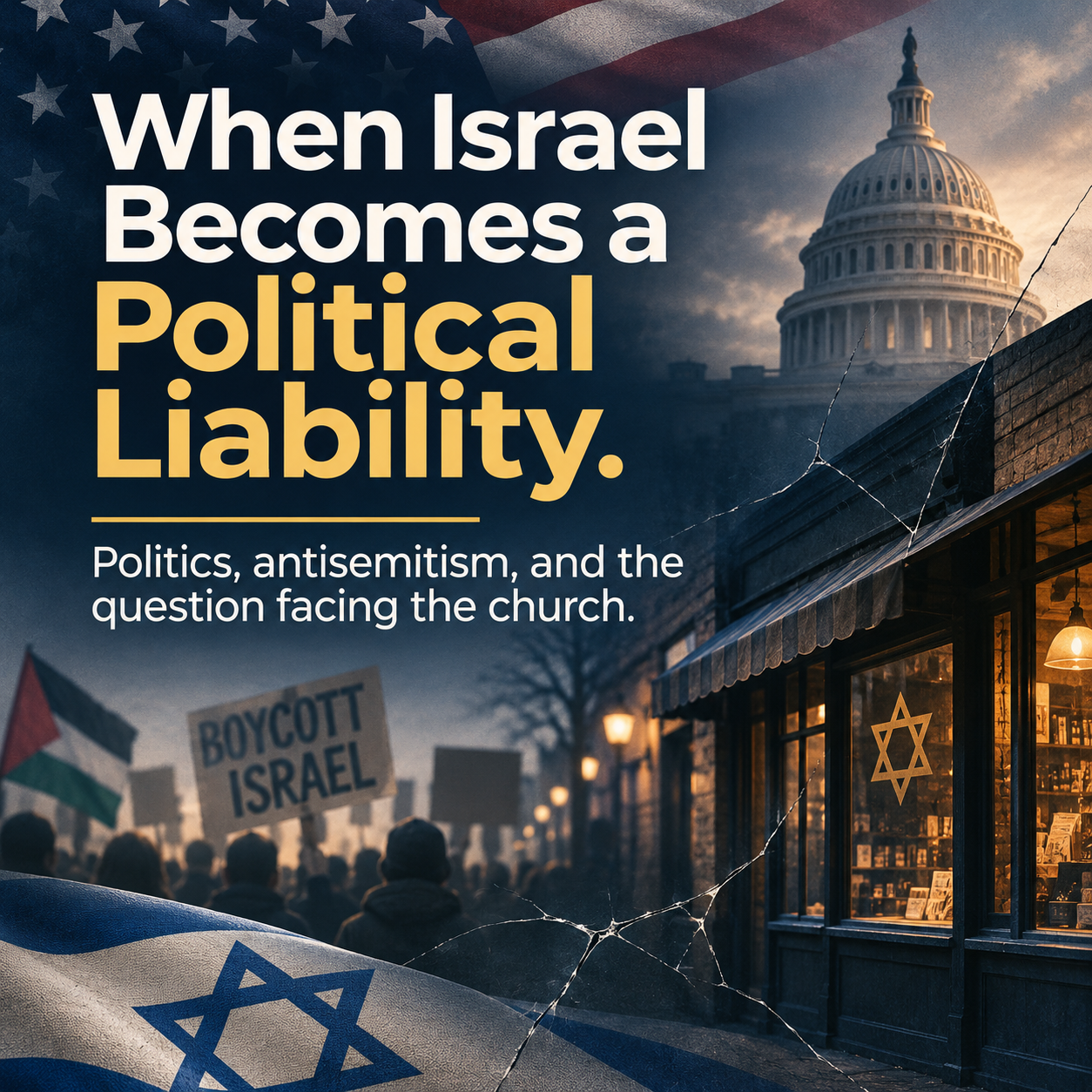
Politics, antisemitism, and the question facing the church
This week, I read a story out of Philadelphia that left me with a feeling I haven't been able to shake. A group calling itself Philly Bike On Your Left has organized a bicycle protest for tomorrow, November 8, calling for the boycott of six Jewish- and Israeli-owned businesses. The organizers describe their effort as a protest against Zionism and businesses they believe are connected to Israel. But the language on their promotional materials, including calls for these establishments to disappear from the city, has understandably alarmed Philadelphia's Jewish community.
Pennsylvania Senators John Fetterman, a Democrat, and Dave McCormick, a Republican, have condemned the planned event, as have Philadelphia Mayor Cherelle Parker and other local officials. Yesterday, Jewish community leaders, elected officials, and faith leaders gathered at one of the targeted restaurants in a public show of support.
You can read the local reporting from WHYY and the Jewish Federation's statement for yourself.
What makes this especially unsettling is the date. Tomorrow's demonstration is scheduled for the day before the 88th anniversary of Kristallnacht, the Night of Broken Glass, when Nazi-organized violence swept through Jewish communities across Germany and Austria.
The organizers have said the timing is coincidental. I can't speak to their intentions, and I believe that distinction matters. But the historical significance is difficult to ignore, particularly when Jewish-owned businesses are once again being publicly identified as establishments that people should avoid.
And as someone who is both Jewish and a business owner, I find myself thinking about this more personally than I might have a few years ago.
What is Kristallnacht?
On November 9–10, 1938, Nazi leaders coordinated a wave of violence against Jewish communities throughout Germany and Austria. More than 1,400 synagogues were burned, thousands of Jewish-owned businesses were vandalized, homes were invaded, and Jewish people were beaten, humiliated, and killed. Approximately 26,000 Jewish men were imprisoned in concentration camps simply because they were Jewish.
The broken glass covering the streets gave the event its name, Kristallnacht. But as the United States Holocaust Memorial Museum explains, this was a state-sponsored campaign of terror, deliberately organized while being presented to the public as spontaneous outrage.
What has always troubled me about Kristallnacht is what happened in the years leading up to it.
On April 1, 1933, more than five years earlier, the Nazis organized a nationwide boycott of Jewish businesses. Uniformed stormtroopers stood outside shops, offices, and professional establishments, intimidating customers and urging Germans to stop doing business with Jews. The campaign lasted only one day, and many Germans ignored it, but it marked an important step in the economic exclusion of Jewish citizens.
The Holocaust Museum's history of that boycott is worth reading, particularly for the photographs of ordinary storefronts suddenly identified as Jewish businesses.
Over the following years, the persecution grew through legislation, economic restrictions, propaganda, and increasingly open hostility. By November 1938, the Nazi regime had created the conditions for a far more violent assault on Jewish life.
I want to be careful here. A planned demonstration in Philadelphia is not equivalent to the government-directed violence of Nazi Germany. Americans have the right to protest, criticize governments, and make decisions about where they spend their money. Comparisons to the Holocaust deserve historical care because exaggeration can obscure the very lessons we're trying to remember.
But there is a serious question worth asking: What happens when the identity or perceived political loyalty of a Jewish business owner becomes sufficient reason to drive that person out of a community's economic life?
That is where the Philadelphia story becomes deeply troubling to me.
Why this is personal…
My dad and I co-founded The Jewish Road because we believe Christians need to understand the Jewish roots of their faith, the Jewish identity of Jesus, and God's continuing purposes for Israel. This work is deeply personal to both of us because we're Jewish believers who love Jesus and love the Jewish people. And, we love the church. And, we love those outside the church.
I'm also a business owner. Outside of ministry, I work with clients, develop projects, serve organizations, and carry the same responsibilities as anyone trying to provide for a family and make an honest living. My work depends on relationships, trust, and people being willing to do business with me.
And I love Israel. I believe the Jewish people have a legitimate and enduring connection to their ancestral homeland, and I believe Israel has a right to exist in peace and security.
So when I read about Jewish-owned businesses being singled out for protest, I begin wondering how far away I am from similar experiences. Could there come a time when my Jewish identity becomes a reason someone chooses not to work with me? Could my support for Israel cause clients or colleagues to question whether they should associate with my business?
I haven't experienced what those Philadelphia business owners are facing, and I don't want to borrow their suffering to make a point about myself. But I understand why stories like this create anxiety within Jewish communities, even among people who live hundreds of miles away.
Consider what it must feel like to operate a restaurant, serve your neighbors, employ people, and contribute to your community, only to discover that your business has appeared on a public list of establishments someone wants removed.
One of the owners, Alan Domb of Schlesinger's Delicatessen, told WHYY that his business would remain open and that he intended to be there personally during the planned protest. His concern extended to other restaurant owners who had done nothing more than build businesses and serve their city.
There is something profoundly ordinary about that, which is precisely why it troubles me. We're talking about people trying to earn a living.
What is Israel thinking right now?
The Philadelphia protest is occurring during a week when the future of America's relationship with Israel has become a major political conversation.
On Election Day, November 3, President Donald Trump announced that the United States would stop providing roughly $4 billion in annual assistance to Israel beginning in 2027, while continuing to sell the country weapons. According to the Associated Press, Trump said he and Israeli Prime Minister Benjamin Netanyahu had discussed such a transition for years.
Whether that announcement becomes policy remains uncertain. The current U.S.–Israel assistance agreement extends through 2028, Congress has an important role in any change, and conversations about restructuring the relationship have been underway for some time.
There are legitimate arguments about foreign aid, national budgets, defense cooperation, and whether Israel should become less dependent on American assistance. Those discussions deserve serious attention, and disagreement over aid should not be confused with hostility toward Jewish people.
Still, the political environment surrounding Israel has changed considerably, and the traditional bipartisan consensus can no longer be taken for granted.
Friends in Israel wrote to me this week describing the uneasiness they are feeling. They weren't simply responding to the results of American elections. They were wrestling with the possibility that Israel may someday need to navigate its security challenges without the level of American support it has known for decades.
That possibility feels very different when you're raising a family in Israel.
Meanwhile, the Anti-Defamation League's 2025 audit offers another reason for concern about Jewish life here in America. The organization documented 6,274 antisemitic incidents last year, a 33% decrease from 2024 but still the third-highest annual total since tracking began in 1979. Physical assaults reached record levels, three people were killed in antisemitic attacks, and 45% of the documented incidents involved elements related to Israel or Zionism.
The decline in total incidents is encouraging, and it deserves acknowledgment. The persistence of violence is deeply concerning.
These figures also make it important to distinguish legitimate criticism of Israeli policy from antisemitism. Advocating for Palestinians, criticizing decisions made by Israel's government, or opposing particular military actions does not automatically make someone antisemitic. But holding Jewish Americans collectively responsible for those decisions, threatening them, or excluding them from public life because they are Jewish crosses a very different line.
What is the church thinking right now?
Another headline caught my attention this week, this one involving a prominent Christian theologian.
During a conference on Romans in Dallas, N. T. Wright described the belief that the modern State of Israel fulfills biblical prophecy as a "totally unbiblical idea." He argued that certain Christian interpretations of Israel's modern restoration have been shaped by recent theological developments, particularly nineteenth-century dispensationalism.
You can read his comments in The Christian Post.
I respect Wright's scholarship, even where I disagree with his conclusions. Christians have interpreted Israel's land promises, the covenants, and the relationship between Israel and the church differently for centuries. We should be willing to study those disagreements carefully and honestly.
My concern reaches beyond any particular interpretive system. It goes back to a question Paul himself asks in Romans 11:1: "Has God rejected his people?" His answer is emphatic: "By no means!"
Paul then spends much of the chapter explaining God's continuing purposes for Israel, using the image of an olive tree into which Gentile believers have been grafted. He explicitly warns those Gentile branches against arrogance toward the natural branches, reminding them that they are supported by the root.
And in Romans 11:28–29, Paul describes Israel as beloved because of the patriarchs, adding that God's gifts and calling are irrevocable.
These passages are central to how I understand God's covenant faithfulness. They are also why I believe the Jewish people and God's promises to them remain important to the unfolding biblical story. Wright's theological position should not be confused with antisemitism. In fact, he has explicitly rejected attempts to sever Christianity from its Jewish roots. But his comments raise an important question about how Christians understand Israel and how our theology shapes the way we view Jewish people today. The church has a painful history of teaching, sometimes explicitly and sometimes through implication, that God was finished with the Jewish people. Those beliefs contributed to attitudes that made Jewish communities vulnerable to exclusion and persecution.
I believe we have a responsibility to examine our theology carefully, especially when it affects how we treat the people through whom God gave us the Scriptures, the covenants, the prophets, and the Messiah Himself. Whatever conclusions Christians reach about modern Israel and biblical prophecy, Jewish people should never have to wonder whether the church will stand against antisemitism.
Is prophecy colliding with the headlines?
For those of us who study the biblical prophets, a week like this naturally raises questions about where Israel's story is heading.
Ezekiel 36–37 speaks of God's determination to gather, restore, and renew Israel for the sake of His holy name. Jeremiah 31 connects God's enduring commitment to Israel with the established order of creation. Zechariah 14 describes a future in which the LORD will be King over all the earth and the nations will come to Jerusalem to worship Him.
These passages have shaped my understanding of God's faithfulness, and they are part of why I believe the modern return of Jewish people to their ancestral homeland deserves serious biblical consideration.
At the same time, we need humility when interpreting current events. Every election, protest, or diplomatic announcement does not necessarily correspond to a particular prophetic passage. Scripture gives us the larger story of God's purposes, and we should resist the temptation to claim certainty about details He has not revealed.
What I find most encouraging is the character of God revealed in these promises. When God speaks through Ezekiel about Israel's future restoration, He repeatedly emphasizes that His actions will demonstrate His faithfulness and make His name known among the nations. Israel's hope ultimately rests in the God who made those promises.
Our friends in Israel reminded me of something similar this week. Their note acknowledged the uncertainty surrounding their country's future, but it also pointed back to Israel's long history of crying out to God in difficult circumstances. For generations, the Jewish people have endured exile, persecution, displacement, war, and uncertainty. And through it all, the biblical story continues to bear witness to a God who remembers His covenant.
I find that both sobering and deeply hopeful.
Before the glass breaks again
On Monday, November 9, we will remember one of the darkest nights in modern Jewish history. I hope we also remember the years that led to it, when Jewish neighbors were gradually excluded from economic life, singled out through propaganda, and treated as though they no longer belonged in the communities they had helped build.
There is an important lesson here about the responsibility of ordinary people. The church has an opportunity to be a voice of clarity and compassion in a moment when many Jewish families are wondering what comes next. That begins with recognizing antisemitism wherever it appears, whether it comes from the political right, the political left, religious communities, or movements that claim to be working for justice.
It means listening carefully to Jewish neighbors, understanding the difference between political criticism and prejudice, and refusing to make innocent people responsible for the actions of governments. It also means recognizing that the suffering of Israelis and Palestinians deserves our concern. Caring about Jewish safety does not diminish the value of Palestinian lives, and defending the rights of Jewish Americans should go hand in hand with defending the dignity and religious freedom of everyone in our communities.
I keep thinking about the people in Philadelphia who are preparing to open their restaurants tomorrow, knowing protesters may arrive outside their doors. I'm grateful for those who gathered yesterday to support them, and I hope their neighbors continue showing up long after the headlines fade.
I think about my friends in Israel, trying to make sense of the future of a relationship their country has depended upon for generations. And I think about my own life as a Jewish business owner, wondering how changes in public sentiment might someday affect the people and relationships closest to me.
I don't know what the coming years will bring. But I do know that Scripture calls us to love our neighbors, defend those who are vulnerable, and reject the kind of pride that allows us to dismiss another person's suffering. And I know the God of Israel has demonstrated His faithfulness through generations of uncertainty. My hope is that the church will be known for its willingness to listen, its courage to speak when Jewish neighbors are threatened, and its commitment to the truth of Scripture, including the promises God made to Israel.
Because we have seen where the gradual exclusion of Jewish people can lead when a society loses its willingness to recognize their dignity.
We shouldn't have to wait for broken glass to recognize when something is wrong.
With you on the road.



About The Jewish Road
At the heart of The Jewish Road lies a passion ignited by a father-son duo, Ron and Matt Davis. Our journey began with a simple yet profound desire: to bridge the gap in understanding that has kept two faith communities apart for too long. We're here to help Christians connect with the roots of their faith and for Jews to explore the life and teachings of Jesus with an open heart.
Imagine a world where every believer, be they Jewish or Christian, not only knows their faith but truly understands its origins and interconnectedness. We strive to restore the Jewish essence of the Gospel, offering insights that deepen knowledge, bolster faith, and propel the growth of the Kingdom. The narrative of faith, we believe, is a two-act play where both acts are essential for a comprehensive grasp of the story. By uniting these acts, we're presenting a more holistic and enriching perspective.
Life is too short to wander without knowing the full essence of your beliefs. Whether you're attending a synagogue or a church, there's so much more to discover. The Jewish Road is here to guide, enlighten, and, most importantly, bring both halves of the story together. Join us on this journey; together